
Sunday Sermon: “The Gift of Living Water”
Readings:
- Exodus 17:3–7
- Romans 5:1–2, 5–80
- John 4:5–42
Lent always leads us into the desert. And in the desert one truth becomes undeniable: we are thirsty. The readings of this Third Sunday of Lent revolve around water — but not merely water. Around thirst — but not merely physical thirst. Around gift — but not merely something given. We could say they revolve around the gift of water. Or the water that is gift. Or the water that is God Himself given to humanity. It sounds almost tangled. But then so is the Gospel of this Sunday. Saint John does not give us a simple moral lesson. He gives us a mystery. And perhaps that is exactly what thirst requires.
The Desert of Thirst (Exodus 17:3–7)
Before we reach Jacob’s well in Samaria, we must pass through the desert of Sinai. Israel has already witnessed astonishing miracles: the Red Sea parted, the bitter waters made sweet, manna falling from heaven. Yet now, in Rephidim, they thirst. And their thirst quickly turns into accusation: “Why did you bring us out of Egypt? Was it to let us die of thirst?”
How fragile memory becomes when the throat is dry. Moses strikes the rock at Horeb, and water flows. The people are saved. Yet the place receives a troubling name: Massah and Meribah — testing and quarrelling — because they dared to ask: “Is the Lord really among us or not?”
This is not merely an ancient question. It is ours: Is God truly among us — when life feels dry? Is He present — when prayer seems empty? Is He near — when the desert stretches endlessly?
Notice something profoundly important: God gives water before He gives the Law at Sinai. He saves before He commands. He reveals His mercy before He demands fidelity. Grace precedes obligation.
Saint Paul later interprets this scene with daring boldness: “They drank from the spiritual rock that accompanied them, and that rock was Christ.” They drank from Christ. Even in the desert. Even before Bethlehem. Even before Calvary. God has always been the One who moves first.
The Gift Before Worthiness (Romans 5:1–2, 5–8)
Saint Paul deepens this logic of grace in his Letter to the Romans: “While we were still sinners, Christ died for us.” Not when we were holy. Not when we had reformed ourselves. Not when we had proved ourselves deserving. While we were still sinners.
This overturns much of our instinctive religious thinking. We often imagine Christianity as a system of moral achievement: improve yourself, conquer your weaknesses, become worthy — and then approach God. But the Gospel says something far more unsettling and far more beautiful: God approaches us first: “God’s love has been poured into our hearts through the Holy Spirit.”
Poured. Again, the language of water. Grace is not a polite drizzle. It is a pouring. And what does Paul emphasise? Hope. Hope that does not disappoint. Hope rooted not in our strength, but in Christ’s initiative. Here is the uncomfortable consolation of Lent: you may not be worthy — but you are not disqualified. The gift is precisely for sinners. The water is precisely for the thirsty.
The Well at Noon (John 4:5–42)
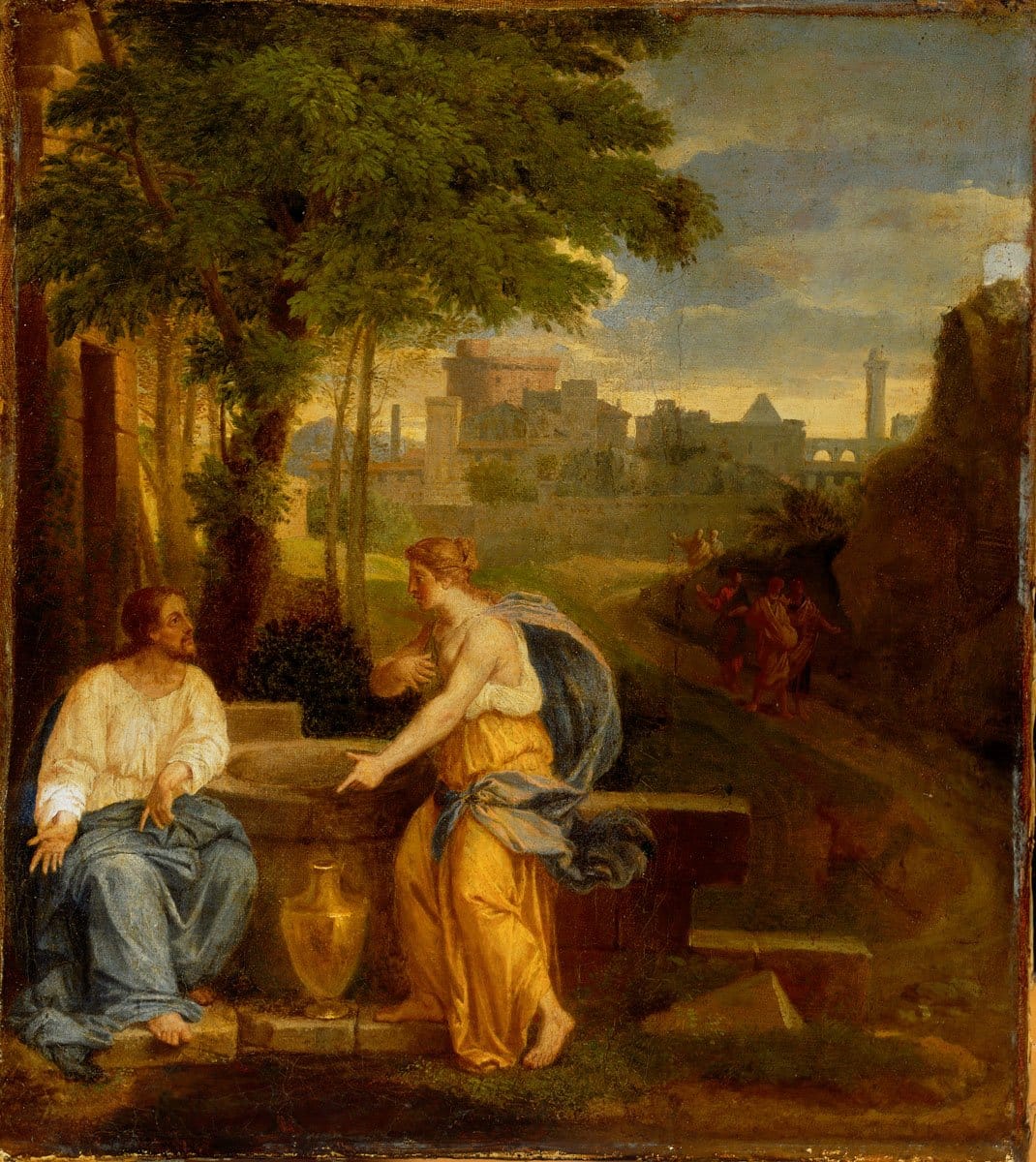
Now we arrive in Samaria. The historical tension between Jews and Samaritans ran deep. Centuries of division, suspicion, theological dispute. They disagreed about the proper place of worship — Jerusalem or Mount Gerizim. They questioned one another’s orthodoxy and purity. And into that fractured history walks Jesus. He is tired. He is thirsty. It is noon — the heat of the day. Yet He does not miss the moment: “Give me a drink.”
The Creator asks His creature for water. Already something extraordinary is happening. God makes Himself vulnerable. He begins not with a sermon, but with a request. Then comes the sentence that opens the entire Gospel: “If you knew the gift of God, and who it is that is saying to you, ‘Give me a drink,’ you would have asked Him, and He would have given you living water.”
Everything rests on knowing two things: the gift — and the Giver. Christianity begins not with effort but with recognition. If you knew who stands before you, you would ask. The Christian is fundamentally someone who asks.
Jesus does not begin with theological definitions. He begins with desire: “Whoever drinks this water will thirst again. But whoever drinks the water I shall give will never thirst; the water I shall give will become in him a spring of water welling up to eternal life.”
This water does not merely quench. It transforms. It does not remain external. It becomes internal. It does not satisfy temporarily. It becomes a source.
Later in the Gospel, Saint John explains that Jesus spoke of the Spirit. But the symbol is even richer. Living water is the Holy Spirit. It is Christ’s teaching. It is Christ Himself. It is the life of the Triune God shared with humanity. In baptism, this becomes visible. Water is poured. But what is truly given is God Himself. The Spirit dwells. A spring begins within the soul. And here we must pause and examine ourselves. How many times have we tried to quench our thirst with things that inevitably fail? Achievement, relationships, distractions, endless information. We drink — and thirst returns. Only one water claims to end thirst forever.
The conversation shifts when Jesus reveals His knowledge of the woman’s life. Not to humiliate her, but to awaken trust. She raises the great religious dispute of her time: Where should we worship? Jesus’ answer is revolutionary: “The hour is coming — indeed it is now — when true worshippers will worship the Father in spirit and in truth.” Not confined to geography. Not reduced to ritual formalism. But neither dissolved into vague spirituality. Spirit — the Holy Spirit.
Truth — and in John’s Gospel, Truth is a Person: Christ Himself. To worship in Spirit and Truth is to worship the Father through the Son in the Holy Spirit. This is not religious relativism. It is fulfilment. Jesus does not abolish the history of Israel — He completes it. And then comes the climax: “who speak to you am He.” The Messiah. The Anointed One. The Source.
The Samaritan woman, barely initiated into faith, becomes a missionary. She does not yet grasp everything. Her theology is incomplete. Her life is complicated. Yet she runs to her town: “Come and see a man who told me everything I have ever done.” Living water flows outward.
For those mature in faith — priests, catechists, committed Christians — the example of Jesus is equally striking. Tired, thirsty, under the sun — yet attentive. The Gospel is not a profession with fixed hours. The harvest remains ready. But perhaps the most important lesson for pastoral life is this: the primacy of grace. We sometimes act as though faith depends entirely on how well we explain, how effectively we organise, how convincingly we argue. Yet the living water is the Holy Spirit. And the Spirit acts. Seeds grow in hidden ways. Springs appear from unseen depths. Conversion often happens beyond our calculations. We must preach, teach, accompany — but never forget that the deepest work is God’s.
And so, at the heart of this Third Sunday of Lent, a simple question remains: Are you thirsty? Not mildly restless. Not slightly dissatisfied. Truly thirsty. The desert exposes our illusions. It strips away substitutes. It forces us to confront the dryness of our own hearts.
If you knew the gift of God… This Lent is not first about what you must do for God. It is about what God longs to give you. Come thirsty. Ask. Receive. And discover that, perhaps unnoticed until now, a spring has already begun to flow within you — a spring welling up to eternal life.
Fr Dominik DOMAGALA