Mass Readings:
- Acts 2:1-11
- 1 Corinthians 12:3-7, 12-13
- John 20:19-23
There are feasts in the Church year that we celebrate almost instinctively. Christmas appeals to the imagination. Easter speaks to the deepest human longing for life stronger than death. Pentecost, however, is often more difficult. The Holy Spirit can seem elusive, abstract, almost impossible to grasp. We understand the Father as Creator. We understand the Son because we see Him walking through the pages of the Gospel. But the Holy Spirit? He often remains, even for believers, strangely anonymous. And yet the readings of Pentecost make one thing unmistakably clear: without the Holy Spirit there is no Christianity. There may still be religious customs, structures, arguments, moral principles and traditions. But there is no living Church. The Holy Spirit is not an ornament added to Christianity. He is its life-breath.
Wind, Fire and Human Speech (Acts 2:1-11)
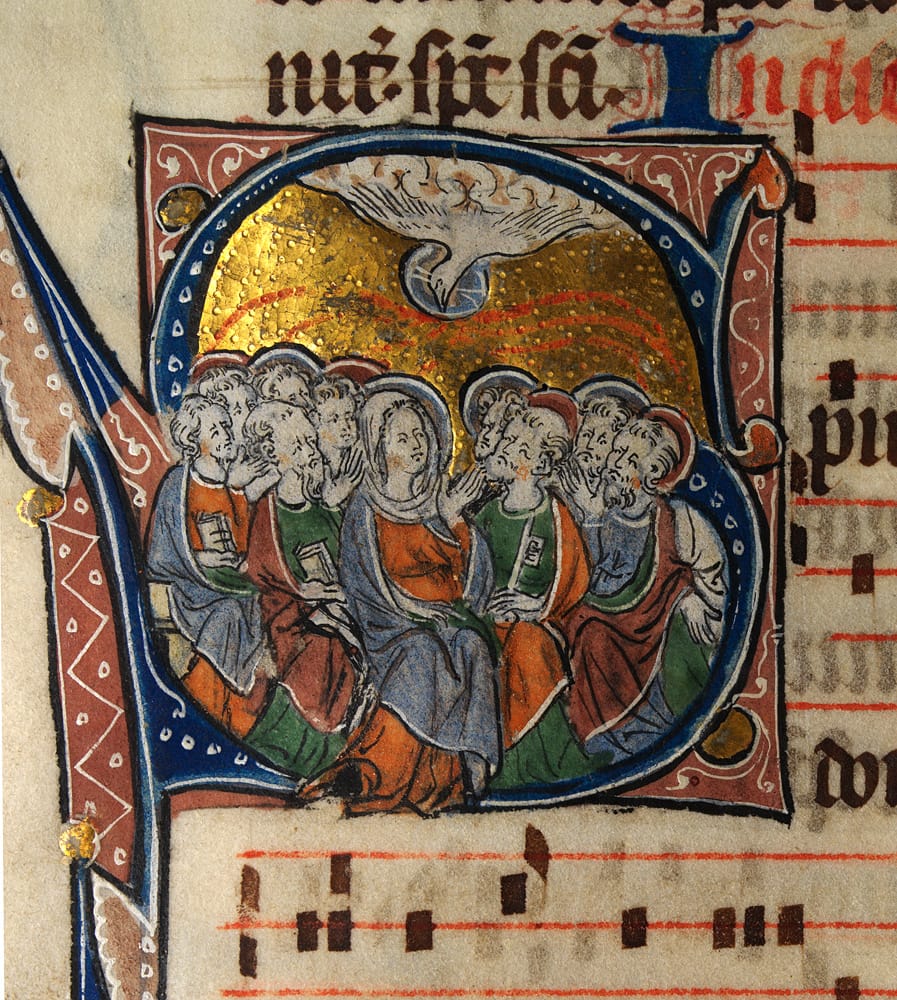
The story from the Acts of the Apostles is familiar enough that we risk no longer hearing its strangeness. The disciples are gathered together in Jerusalem fifty days after Passover. The city is crowded because Jews from across the known world have arrived for the feast of Shavuot, the Feast of Weeks. Originally it had been a harvest festival, thanksgiving for the first fruits of the earth. But over time it also became the celebration of God giving the Law to Israel on Mount Sinai. And it is precisely on that feast day that the Holy Spirit descends.
This is not accidental. Pentecost is not simply an emotional spiritual event added to the Gospel story. It is the completion of something that began long before. At Sinai, God gave His people the Law written on stone tablets. But already the prophets understood that something deeper was needed. Jeremiah spoke of a day when God would write His law not on stone but upon the human heart. Ezekiel went further still: “I will give you a new heart, and put a new spirit within you.” That promise is fulfilled at Pentecost. The Spirit descends not merely to inspire the Apostles emotionally, but to create a new humanity. Christianity is not simply a moral system imposed from outside. It is life transformed from within. The law of God becomes interior. What once appeared as commandment gradually becomes desire. The Christian begins not merely to obey God reluctantly, but to love what God loves. This is why Pentecost is, in a profound sense, the true birth of the Church. Before this moment the disciples still live half-hidden, uncertain and fearful. After Pentecost they step into the streets of Jerusalem openly. The same men who had locked themselves in the Upper Room now preach publicly before crowds. Something decisive has changed.
Saint Luke describes that change through signs that are both mysterious and deeply biblical: wind, fire and speech. First there is the sound “like a mighty rushing wind.” In both Hebrew and Greek the same word can mean wind, breath or spirit. One immediately thinks of the opening of Genesis, where the Spirit of God hovers over the waters before creation begins. Pentecost is therefore not merely encouragement for discouraged disciples. It is a new creation. God breathes again over chaos. Then there is fire. Throughout Scripture fire accompanies the presence of God: the burning bush before Moses, the fire upon Sinai, the pillar of fire leading Israel through the desert. Fire both illuminates and purifies. It gives warmth, but it also consumes. The fire of Pentecost is not comfortable religious sentimentality. The Holy Spirit does not simply reassure people. He transforms them. And finally there is the miracle of languages. The Apostles speak, and pilgrims from every nation hear the Gospel in their own tongue. This is more than a miracle of communication. It is the reversal of Babel. At Babel humanity tried to build unity through pride, power and self-assertion. The result was confusion and division. At Pentecost unity is restored not through human ambition but through humble openness to God. The Church becomes a place where difference is not abolished but gathered into communion. This remains one of the most important signs of the Holy Spirit. The Spirit creates unity without destroying personality. He does not produce uniformity, but harmony.
The Spirit Does Not Create Factions (1 Corinthians 12:3-7, 12-13)
That matters greatly in our own age. Modern society is full of noise about division, conflict and identity. Even within the Church Catholics increasingly define themselves through opposition: conservative against progressive, traditional against modern, one group against another. And yet the Holy Spirit consistently moves in the opposite direction. He gathers. He reconciles. He builds communion. This does not mean that truth becomes irrelevant or that every disagreement disappears. Pentecost is not sentimental optimism. But it does mean that the ultimate purpose of truth is not victory over opponents, but leading people into Christ.
Saint Paul develops precisely this point in the second reading. Writing to the troubled Church in Corinth — a community full of tensions, rivalries and competing egos — he reminds them that all gifts come from the same Spirit. Some receive gifts of teaching, others leadership, others service. Yet none of these gifts are given for personal glory. They are entrusted for the good of the whole body. This remains an urgently necessary lesson. Christians often fall into two opposite errors. Some reduce the Church entirely to hierarchy and office, as though the Holy Spirit acts only through official structures. Others imagine spirituality without structure, authority or obedience. Saint Paul avoids both extremes. The Spirit works through the Church, but He also distributes charisms freely among the faithful. And perhaps one of the most humbling lines in the entire New Testament appears here almost quietly: “No one can say ‘Jesus is Lord’ except by the Holy Spirit.” Even faith itself is already grace. That should change the way how we look at one another. Every sincere confession of Christ already bears the trace of the Spirit’s work. It should also make us cautious about arrogance in matters of faith. The Holy Spirit is not our possession. He cannot be monopolised by factions, movements or religious self-confidence.
Christ Breathes Again Upon Humanity (John 20:19-23)
The Gospel takes us back to Easter evening. The disciples are once again behind locked doors, afraid. Into that fear the risen Christ comes and says simply: “Peace be with you.” It is important to notice what Jesus does not say. He does not reproach them for abandoning Him. He does not humiliate them for their weakness. He comes bearing peace. And then comes one of the most extraordinary gestures in all Scripture: “He breathed on them.” The wording deliberately echoes Genesis, where God breathes life into Adam. Humanity, wounded by sin and death, now receives new life from the risen Christ. This is recreation after redemption. And immediately this gift of the Spirit becomes linked with forgiveness: “Whose sins you forgive are forgiven them.” That connection matters profoundly. The Holy Spirit is not given merely for emotional comfort or spiritual experiences. He is given for reconciliation, healing and salvation. The Spirit creates a Church capable of drawing people back from spiritual death into life. Which means that the mission of the Church can never simply be ideological. Christianity is not ultimately about winning arguments, defending cultural identity or preserving social influence. The deepest task of the Church is always to bring people to Christ, and therefore to forgiveness and life.
Perhaps this is why genuinely Spirit-filled Christians so often possess an unmistakable peace. Not naïveté. Not indifference to evil. But peace. They know that history ultimately belongs not to chaos, political systems or cultural trends, but to the risen Christ. The Church today often appears weak. In many places it shrinks numerically. Faith grows colder. Scandals wound credibility. But Pentecost reminds us that Christianity did not begin through human strength, efficiency or popularity. It began through the breath of God. And if the Spirit could transform frightened fishermen into apostles capable of changing the world, then He is not powerless now.
The real question is whether we still believe that the Church lives by the Holy Spirit — or whether we have quietly begun to trust more in strategies, anxieties and human calculations. Because in the end, Pentecost is not merely a memory of something that once happened. It is the permanent condition of the Church. Christianity either lives by the Spirit of God, or it slowly becomes only a museum of religious memories. And the world does not need another museum. It needs people whose hearts have truly caught fire.
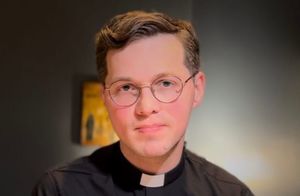
Fr. Dominik Domagala acquired a Master's in History of Liturgy and obtained a Licentiate in Sacred Scripture at St Patrick’s College in Maynooth. His main interests concern the OT and Books of Maccabees. He is the author of “The Social Sermon” blog on Facebook, Instagram and YouTube. Check out more at the new website: thesocialsermon.com