

Mass Readings:
- Wisdom 12:13, 16-19
- Romans 8:26-27
- Matthew 13:24-43
There is scarcely a question more frequently asked than this: Why does God allow evil? Why does He permit injustice to flourish, the innocent to suffer, the wicked to prosper, and cruelty to scar the lives of countless people? If God is all-powerful, why does He not simply intervene, remove evil from the world, and punish those responsible? Yet one cannot help noticing a curious contradiction in the human heart. Were God to strike every sinner with immediate judgement, many would denounce Him as merciless and severe. If, however, He grants time for repentance, He is accused of indifference. We often expect God to act swiftly against the sins of others, while hoping He will deal patiently with our own. The Scriptures proclaimed this Sunday reveal something altogether different. They present God whose justice is inseparable from His mercy, whose infinite power is revealed not in sudden vengeance but in extraordinary patience.
Strength Revealed Through Mercy (Wisdom 12:13, 16-19)
The First Reading, taken from the Book of Wisdom, belongs to one of the latest books of the Old Testament. Written in Greek, most probably in Alexandria during the centuries immediately preceding Christ, it reflects the mature faith of the Jewish diaspora living amidst the intellectual currents of the Hellenistic world. Looking back upon Israel's history, the sacred author contemplates God's dealings with the pagan nations, especially the inhabitants of Canaan. To modern readers, some of those Old Testament narratives may appear severe. Yet the inspired writer draws precisely the opposite conclusion. God, he insists, exercised remarkable restraint: ”Your sovereignty over all makes you lenient to all.” This is one of the most profound descriptions of divine justice. God's mercy is not the result of weakness, uncertainty or hesitation. It springs from His absolute sovereignty. Because nothing can ultimately frustrate His purposes, He is never compelled to act rashly or to prove His authority through displays of force. How different this is from human behaviour. We often become impatient because we fear losing control. We rush to judgement because we are anxious that injustice may prevail. God never suffers such anxiety. He sees the whole tapestry of history, while we glimpse only a few threads. The author of Wisdom therefore makes a striking observation: God's power teaches His people how they themselves ought to behave: "By acting thus you have taught a lesson to your people how the virtuous must be kindly to his fellow.” Justice and kindness are not opposing virtues. In God's eyes they belong together. Indeed, the measure of authentic justice is not severity but charity. The final sentence of the reading offers perhaps its greatest consolation: God gives sinners the opportunity to repent.
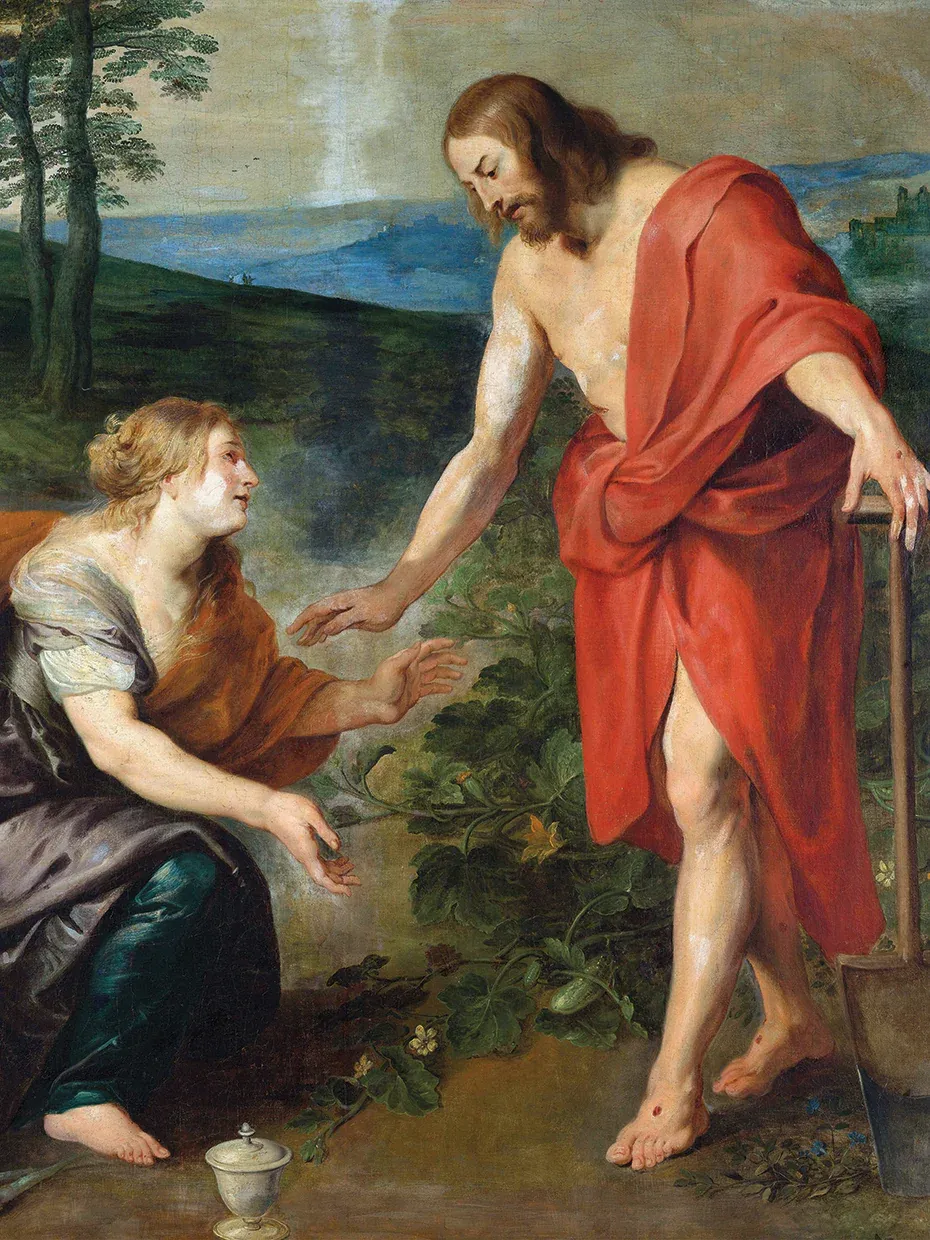
How desperately our own age needs to recover this truth. Public life increasingly encourages instant condemnation. Social media has accustomed us to rapid verdicts, permanent labels and little room for conversion. Yet God's way is altogether different. He never trivialises sin, but neither does He abandon the sinner. In this respect, the Church's calendar provides a beautiful illustration. This coming Wednesday we shall celebrate the feast of Saint Mary Magdalene. Whatever debates may surround the details of her earlier life, the Gospels present her as a woman profoundly transformed by the mercy of Christ. The Lord refused to define her by her past. Others might have seen only brokenness; Jesus saw the saint she could become. The woman who had once needed healing became the first witness of the Resurrection, honoured by the ancient Church as the Apostle to the Apostles. God's patience accomplished what human judgement never could.
When We Cannot Find the Words (Romans 8:26-27)
Saint Paul's teaching in the Letter to the Romans brings us from God's patience towards sinners to His astonishing tenderness towards believers. Even those who have accepted Christ continue to experience weakness. Faith does not remove every struggle. Christians wrestle with temptation to sin, discouragement and uncertainty. Sometimes they discover that the greatest difficulty is prayer itself. Who has not known those moments when words simply fail? There are seasons when prayer feels dry, distracted or empty. We wish to pray, yet cannot find the language or will. It is precisely here that Saint Paul offers one of the New Testament's most comforting assurances: "The Spirit comes to help us in our weakness.” The Apostle uses an expressive Greek word, stenagmos—a sigh or groaning too deep for words. The Holy Spirit prays within us with those inexpressible sighs that arise from the depths of the heart. Even when we believe ourselves incapable of praying, God is already at work within us. What an extraordinary mystery. The Father searches the human heart. The Spirit intercedes within it. And Christ Himself, our eternal High Priest, continually intercedes for us before the Father. This same confidence allows Christians to be patient not only with others but also with themselves. Spiritual growth rarely occurs overnight. Holiness matures slowly, often through countless hidden acts of grace that only God can see. As with Mary Magdalene, the Lord is never discouraged by how far we have yet to travel. He sees already what His grace intends to accomplish.
The Kingdom Grows in God's Time (Matthew 13:24-43)
The Gospel continues Saint Matthew's great discourse on the Kingdom of Heaven. Last Sunday's Parable of the Sower is now followed by three further images: the wheat and the weeds, the mustard seed and the yeast. Although different in form, they proclaim one and the same truth: God's Kingdom possesses within itself a divine power of growth, yet that growth unfolds according to God's timetable rather than ours. The first parable is perhaps the most challenging. A farmer discovers that an enemy has secretly sown weeds among his wheat. His servants, understandably eager to protect the crop, ask whether they should pull the weeds up immediately. The master's answer is unexpected. "No," he replies, "because when you weed out the darnel you might pull up the wheat with it. Let them both grow till the harvest.” Our instinct is almost always to separate immediately what is good from what is evil. But Christ counsels patience. This does not mean that evil is ignored, excused or accepted. The weeds remain weeds. They are destined for judgement. But the judgement belongs to God, not to us. Human beings rarely possess the wisdom to distinguish perfectly between the sinner and the sin, between what is beyond hope and what is still capable of redemption. Indeed, when Our Lord later explains the parable to His disciples, He makes an observation that deserves careful attention. At the final harvest, the angels gather not only "all who do evil" but also "all things that provoke offences"—everything that has scandalised, wounded and led others away from God. In the Gospel, scandal is not merely something shocking. It is whatever causes another person to stumble, whatever weakens faith, destroys hope or provokes bitterness. Cruel words, humiliations, unjust accusations, contempt, persistent mockery, or the careless abuse of another's dignity can all become stumbling blocks upon another's path towards God. How readily we condemn spectacular sins while overlooking the smaller daily acts that slowly poison hearts and relationships.
The Church's calendar once again provides a beautiful commentary on today’s Gospel, since next Saturday we celebrate the feast of Saint James the Apostle. We often remember James as the first of the Apostles to shed his blood for Christ. Yet before he became a courageous martyr, he had much to learn about the patience of God. Together with his brother John, James once wished to call down fire from heaven upon a Samaritan village because its inhabitants had rejected Jesus. It was the instinctive response of wounded zeal: punish immediately, judge swiftly, repay rejection with destruction. But Christ firmly rebuked him.
Trusting the Harvest
Taken together, this Sunday's readings paint a remarkably consistent portrait of God. He is infinitely powerful, yet astonishingly gentle. He is perfectly just, yet wonderfully patient. He knows the end of history already, and therefore He is never anxious, never hurried, never driven by fear. Because He knows the harvest, He can afford to wait for the wheat to ripen. We, on the other hand, see only the present moment. That is why Christians must be cautious whenever they are tempted to issue final verdicts about people, institutions or even the state of the world. What appears today to be barren may still bear some fruit. This does not mean abandoning moral clarity. Evil remains evil. Sin must never be excused or redefined. Yet truth itself must always be spoken with the charity that reflects the very heart of God. And as we celebrate Saint Mary Magdalene on Wednesday and Saint James on Saturday, we are reminded that holiness is not born in a single moment. It is the patient work of divine grace. One saint teaches us that no sinner is beyond redemption. The other teaches us that even the most impetuous disciple can be transformed into a fearless Apostle. Their lives proclaim exactly what this Sunday's Scriptures reveal. God's justice is never separated from His mercy and His Kingdom, though often growing silently and unseen, is already moving towards the harvest that He alone has prepared from the foundation of the world.
Fr. Dominik Domagala acquired a Master's in History of Liturgy and obtained a Licentiate in Sacred Scripture at St Patrick’s College in Maynooth. His main interests concern the OT and Books of Maccabees. He is the author of “The Social Sermon” blog on Facebook, Instagram and YouTube. Check out more at the website: thesocialsermon.com