Mass Readings:
- Isaiah 45:1,4-6
- 1 Thessalonians 1:1-5
- Matthew 22:15-21
There is a certain danger in speaking too confidently about God. We can become so accustomed to our own religious language that we begin to imagine we have understood His methods: we know whom He ought to choose, how He ought to act, and which people He ought to favour. We speak readily of God’s will, sometimes with the assurance of those who have been entrusted with the divine plans themselves. Yet Sacred Scripture repeatedly reminds us that God is not confined by our expectations, nor can His providence be reduced to the political, social or religious categories through which we interpret the world.
The readings for this Sunday offer a striking illustration of this truth. They speak of a pagan king chosen to accomplish God’s purposes, a Christian community whose life is rooted in divine grace, and a confrontation between Jesus and those who wish to entrap Him in a political controversy. Together, they invite us to consider a question that remains as pertinent in our own time as it was in the ancient world: who ultimately possesses authority over our lives, and what happens when the claims of earthly power encounter the sovereignty of God?
The Persian King Chosen by God (Isaiah 45:1,4-6)
The first reading, taken from the prophet Isaiah, contains a statement that must have sounded astonishing to its original audience: the Lord addresses Cyrus, king of Persia, as His anointed. The Hebrew word is mashiach, meaning one who has been anointed. Although the word would eventually acquire its full messianic significance in the expectation of the coming Saviour, its use here does not mean that Cyrus is the Messiah in the Christian sense. Rather, God appoints him to fulfil a particular purpose in the history of His people. The historical circumstances make this choice all the more remarkable. In 586 BC, Jerusalem fell to the Babylonians, the Temple was destroyed, and many of the people of Judah were carried into exile. Their future seemed uncertain, and their national and religious life had suffered a devastating blow. Yet, in 539 BC, Cyrus conquered Babylon. Unlike some previous conquerors, he permitted displaced peoples, including the Jewish exiles, to return to their homelands and restore their sanctuaries. His policy was not necessarily motivated by devotion to the God of Israel. It reflected, at least in part, the practical interests of an expanding Persian empire, which sought stability and loyalty among its subject peoples. Nevertheless, Isaiah interprets these events through the eyes of faith. God can employ the political calculations of a pagan ruler to accomplish His purposes, even when that ruler does not know Him. Cyrus is not presented as a model of perfect holiness, nor does his appointment mean that every decision he makes is approved by heaven. He is an instrument of providence, and the prophet’s central concern is to proclaim that the Lord alone is God, the sovereign of history and of all nations. This is an important distinction. God’s ability to work through a ruler does not make that ruler’s every action an expression of God’s will. Divine providence is not the same as divine endorsement. The Lord may bring good out of the actions of imperfect people without removing their responsibility for what they do. The lesson would have been difficult for a people tempted to imagine that God’s purposes could be fulfilled only through familiar religious institutions or through a ruler of their own choosing. Instead, restoration came through an unexpected source. God’s faithfulness remained constant, even when the means by which He fulfilled His promises confounded human expectations.
The Church is Founded in Grace (1 Thessalonians 1:1-5)
The second reading, from the opening of St Paul’s First Letter to the Thessalonians, takes us from the political history of Israel to the life of the early Church. Probably the earliest surviving writing of the New Testament, composed around AD 50–51, the letter was addressed to a Christian community established during Paul’s missionary journeys. Paul writes with Silvanus and Timothy, greeting the Thessalonians as a Church “in God the Father and the Lord Jesus Christ”. That small word, in, deserves attention. The Church is not merely a gathering of people who share certain ideas, customs or social interests. Its deepest identity is found in its relationship with God through Jesus Christ. Its unity cannot be reduced to a common cultural background, a political allegiance or even the personal qualities of its members. The Church lives from a gift that precedes all human achievement: the grace of God. Paul’s greeting, “Grace to you and peace”, is therefore more than a courteous formula. Grace is the unmerited gift through which God draws us into His life, while peace is the fruit of reconciliation with Him. Paul goes on to praise the Thessalonians for their “work of faith and labour of love and steadfastness of hope”. These are not abstract virtues to be admired from a distance. Faith bears fruit in action, love demands effort and sacrifice, and hope requires perseverance when circumstances become difficult. Even here, the primacy of grace remains essential. The Gospel reached Thessalonica through human preaching, but it came, Paul insists, not simply in words but in power and in the Holy Spirit. Evangelisation requires the work of human beings, yet conversion cannot be manufactured by eloquence, organisation or persuasion alone. The preacher serves; God gives the growth. The same principle should shape the Church’s engagement with public life. We are called to work diligently for the common good, but we must never imagine that the Kingdom of God can be reduced to the success of a political movement or the implementation of a particular programme. The Church’s mission is greater than any political project because it concerns the transformation of the human person in Christ.
The Trap Set for Jesus (Matthew 22:15-21)
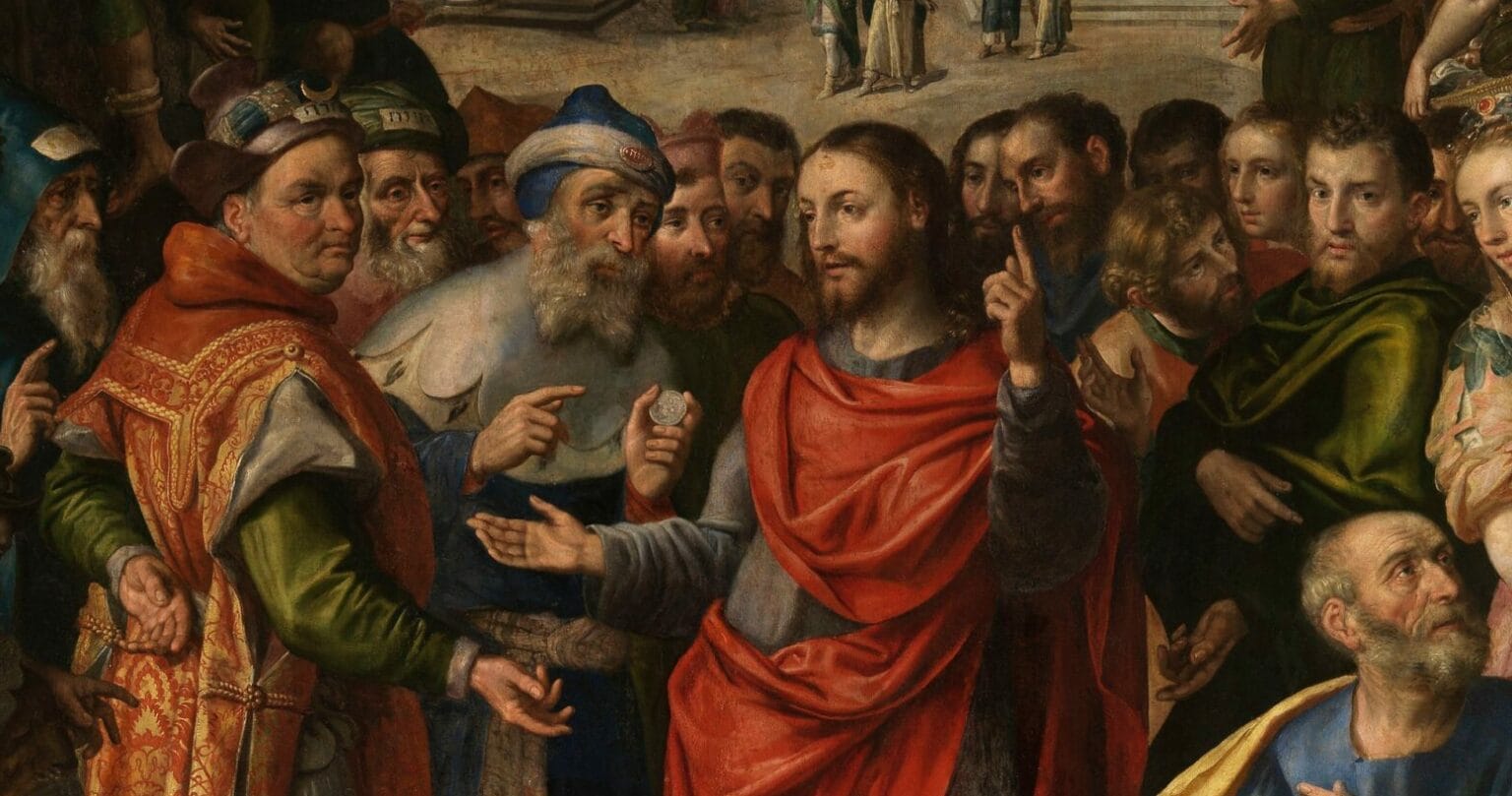
In the Gospel, the question of authority becomes more immediate and contentious. Jesus has entered Jerusalem, and the conflict between Him and the religious authorities is intensifying. The chief priests and elders have already been challenged by His teaching and by His parables. Now the Pharisees join forces with the Herodians, a group generally associated with support for Herod Antipas and the existing political order, to devise a question that appears straightforward but is intended to trap Him: “Is it permissible to pay taxes to Caesar or not?” The question touches a sensitive nerve in first-century Judea. The Roman authorities imposed taxation upon a people living under foreign rule, and the emperor’s image on the denarius served as a reminder of imperial power. To answer that the tax should be paid could expose Jesus to accusations of collaboration with the occupying power; to reject it could provide grounds for accusing Him of rebellion against Rome. Before asking their question, His opponents flatter Him extravagantly, praising His truthfulness and impartiality. Their words sound like a tribute to virtue, but their intentions reveal the opposite. They are not seeking truth; they are looking for a weapon with which to discredit Him. There is something familiar about this manoeuvre. Questions are not always asked in order to discover an answer. Sometimes they are designed to force another person into a choice between two unacceptable alternatives, while concealing the assumptions that make the dilemma appear unavoidable. Political and religious debate can become especially vulnerable to this kind of manipulation, in which flattery, selective reasoning and hostility replace an honest search for what is true. Jesus refuses to be confined by the terms of the trap. Asking whose image appears on the coin, He receives the answer, “Caesar’s.” His reply is memorable: “Render therefore to Caesar the things that are Caesar’s, and to God the things that are God’s.” Jesus does not dismiss the existence of civil authority, nor does He suggest that every obligation to the state is incompatible with fidelity to God. Human society requires legitimate authority, and the payment of taxes can be a proper contribution to the common good. Yet His answer does not grant the state unlimited jurisdiction over human life. The distinction between Caesar and God is precisely what prevents Caesar from becoming a god.
Civil authority has a legitimate sphere, but it is not absolute. Governments may establish laws, administer justice, protect citizens and organise the common affairs of society. They cannot, however, demand the worship that belongs to God, nor can they make moral truth whatever happens to suit the interests of those in power. The state does not acquire the right to command evil merely because it possesses the means to enforce its commands. This principle is central to the Catholic understanding of political life. The Church recognises the proper autonomy of earthly affairs and does not claim that every political question has a single, immediately obvious Catholic answer. Catholics may reasonably disagree about taxation, economic policy, the organisation of public services or the best means of addressing social problems. Such questions require prudence, evidence and a willingness to consider different approaches. Nevertheless, political choices are not exempt from moral judgement. No government stands above the dignity of the human person or the moral law. Where civil authority commands what is contrary to the fundamental demands of conscience, obedience cannot be treated as an unlimited obligation. The Christian must render to Caesar what is genuinely Caesar’s, without surrendering to Caesar what belongs to God. This also guards against two opposing temptations. One is to condemn every government simply because it is led by a party or politician whom we dislike. The other is to defend every action of a political leader whose ideology happens to resemble our own. Both temptations confuse the contingent world of politics with the unchanging demands of truth. A ruler may accomplish something good without being righteous in every respect, just as a government with admirable intentions may adopt policies that deserve serious moral criticism. Nor does the fact that God can bring good from political events mean that every political development should be celebrated as His direct intervention. As the example of Cyrus demonstrates, providence is greater than our political allegiances. The proper Christian response is neither cynicism nor naïve enthusiasm, but a discerning judgement formed by faith, reason and charity.
St John Paul II: The Freedom of the Human Person
This distinction between legitimate authority and political absolutism provides a natural bridge to the feast of St John Paul II, celebrated this Thursday, 22 of October. His life and teaching offer a particularly powerful witness to the truth that no earthly power can rightfully claim the place of God. Karol Wojtyła experienced the brutality of Nazi occupation in Poland and later lived under a Communist regime that sought to subordinate public life to an atheistic ideology. He knew what it meant for political power to reach beyond its proper limits, attempting not merely to govern citizens but to shape their beliefs, control their consciences and determine the meaning of human existence. His experience was not unique to him, nor did he alone bring about the eventual collapse of Communist rule in Eastern Europe. Yet his ministry as priest, bishop and Pope became an important part of a wider movement that affirmed the dignity and freedom of peoples living under oppressive systems. In his encyclical Centesimus Annus, published in 1991 in the aftermath of the dramatic changes in Eastern Europe, John Paul II reflected on the moral foundations of political freedom. He welcomed the rejection of totalitarian systems while warning that democracy itself could become unstable if detached from moral truth. Freedom, in the Christian understanding, is not simply the ability to choose whatever one desires; it is the capacity to pursue what is good, in accordance with the truth about the human person. The state must therefore respect rights that it does not create and cannot legitimately abolish at will. Human dignity does not depend upon the approval of a government, the popularity of a political party or the usefulness of an individual to the economy. It rests upon the truth that every human person is created by God and called to a destiny that transcends earthly political arrangements. John Paul II’s witness also reminds us that Christians need not withdraw from public life in order to remain faithful to the Gospel. On the contrary, they are called to participate in society, defend the vulnerable, seek justice and contribute to the common good. But they must do so without confusing the Church with any political party or placing their ultimate hope in any earthly leader. The Gospel can judge every political system precisely because it belongs entirely to none of them.
The readings of this Sunday bring us back to the question with which we began. We cannot always recognise in advance the ways through which God will work. He may employ an unexpected instrument, as He did with Cyrus; He may bring forth faith through the ordinary witness of a Christian community; and He may expose the false assumptions hidden within a question designed to ensnare the innocent. Our task is not to baptise every political preference by calling it God’s will, but to learn to distinguish what belongs to Caesar from what belongs to God. We owe our society responsible participation, honest work, respect for legitimate authority and concern for our neighbours. We owe God something no earthly power can claim: the worship of our hearts, the obedience of our conscience to His truth and the ultimate allegiance of our lives. Such allegiance should also shape the way we speak to one another. The flattery employed by Jesus’ opponents was a form of dishonesty disguised as respect. Christian witness requires something better: the courage to speak truthfully without malice, to disagree without contempt and to resist the temptation to turn every public question into a contest between enemies. A Church that proclaims grace and peace must strive to embody those gifts, even when the surrounding culture rewards resentment and division. Ultimately, the coin bears Caesar’s image, but the human person bears the image of God. That is the deeper truth beneath Christ’s answer, and it is why the claims of political power, however formidable they may appear, can never be final. Governments change, empires fall and political programmes pass away. The Lord alone is God, and the dignity He bestows upon the human person cannot rightly be taken away by any earthly ruler. To render to Caesar what belongs to Caesar is a responsibility of Christian citizenship; to render to God what belongs to God is the foundation of Christian freedom.
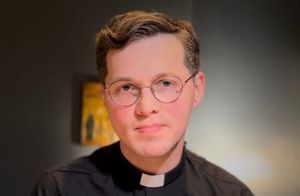
Fr Dominik Domagala