
Mass Readings:
- Isaiah 55:10-11
- Romans 8:18-23
- Matthew 13:1-23
There is a peculiar temptation of every age to imagine that words possess little weight. We are surrounded by promises lightly made, opinions hastily uttered, and declarations forgotten almost as soon as they are spoken. Public discourse often resembles autumn leaves scattered before the wind—abundant for a moment, yet leaving scarcely a trace upon the ground. Holy Scripture presents us with an altogether different vision. In the pages of the Bible, a word is never merely a sound. When God speaks, reality itself begins to change. His word creates, calls, judges, heals, consoles, and saves. It is not empty rhetoric but living power. This Sunday the prophet Isaiah, St Paul and Our Lord each invite us to rediscover a truth that modern society is in danger of forgetting: God's promises never fail. The only question that remains is whether our hearts are ready to receive them.
God Never Speaks in Vain (Isaiah 55:10-11)
The magnificent oracle from Isaiah belongs to what scholars commonly call Deutero-Isaiah, the second great division of this prophetic book, composed during the closing years of the Babylonian Exile in the sixth century before Christ. Jerusalem lay desolate. The Temple had fallen. God's chosen people were scattered, humiliated and tempted to believe that the covenant itself had perished. It was precisely into such darkness that the prophet proclaimed hope: ”As the rain and the snow come down from the heavens... so the word that goes from my mouth does not return to me empty.” The comparison is striking in its simplicity. Rain does not argue with the earth; it simply falls. Snow does not announce its arrival with fanfare; yet silently it nourishes the soil from which new life will emerge. Long before the harvest appears, hidden processes have already begun. So it is with the Word of God. The Hebrew Scriptures employ the remarkable word dabar, a term which signifies not merely speech but action, event and reality. God's Word is never an empty sound. When He speaks, creation itself responds. His speech accomplishes what human language can only describe. For the exiles, this was not an abstract theological proposition but a promise upon which they were asked to stake their future. They were to leave captivity, return home and rebuild the Holy City because God had spoken. The circumstances seemed unpromising, yet the divine promise was more trustworthy than visible evidence. History vindicated the prophet. The return did indeed come. It proved more modest than many had imagined and richer than they had anticipated. Israel recovered not merely a homeland but a renewed covenantal identity. The Fathers of the Church perceived an even greater fulfilment. They recognised that Isaiah's words reached their perfection in Christ Himself. The eternal Logos—the Word made flesh—came into the world to accomplish perfectly the Father's will. Unlike every human messenger, He fulfilled His mission entirely. In Him, God's Word returned bearing the richest possible harvest: the redemption of the world.
Hope Beyond Present Suffering (Romans 8:18-23)
Saint Paul's words to the Christians in Rome broaden the horizon still further. The Roman Church was no stranger to suffering. Only a few years earlier, under Emperor Claudius, many Jewish Christians had experienced expulsion from the city. They knew uncertainty, loss and displacement. Yet Paul writes with extraordinary serenity: "I think that what we suffer in this life can never be compared to the glory, as yet unrevealed, which is waiting for us.” Such confidence is not born of naïve optimism. Christianity has never promised an existence free from sorrow. Illness, disappointment, advancing years, loneliness and bereavement belong to every generation. The Cross remains planted firmly within history, but suffering never possesses the final word. One of the most beautiful features of this passage is Paul's insistence that redemption extends beyond humankind alone. He speaks of the whole of creation waiting in eager expectation. The Greek word ktisis embraces the entire created order—the mountains and rivers, forests and seas, every living creature and every star in the heavens. Creation itself has become subject to decay, yet creation itself shall also share in glory. This profoundly biblical vision deserves to be recovered in an age increasingly anxious about the future of our planet. Christianity should never accept any of two extremes: despising creation nor worshiping it. Rather, it should always proclaim that the world belongs to God and that His saving purpose extends to all that His hands have made. The Book of Revelation speaks of "a new heaven and a new earth." This need not suggest the annihilation of the present universe and its replacement by another entirely different one. The Christian hope is rather one of transfiguration. This world, so often scarred by sin, shall finally become what its Creator intended from the beginning. For anyone who has ever stood in silent wonder before the Atlantic, climbed an Irish mountain, walked through ancient woodland or watched the evening sun settle over quiet fields, this promise possesses immense consolation.
The Generosity of the Divine Sower (Matthew 13:1-23)
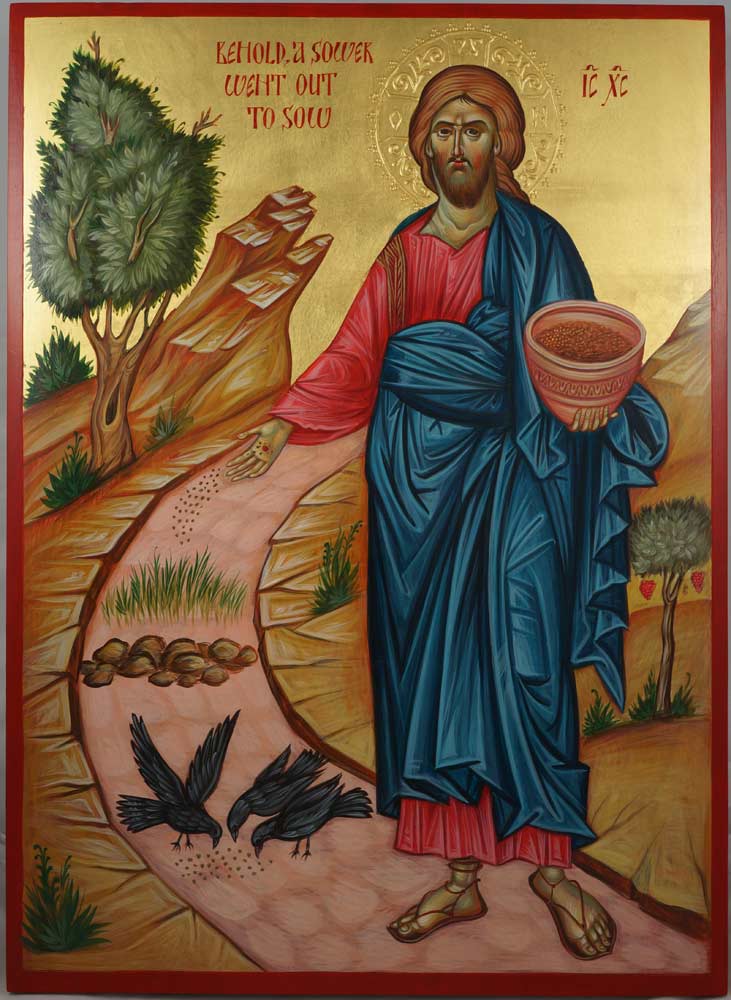
Against this magnificent backdrop comes Christ's familiar parable of the sower. The scene itself is almost sacramental in its simplicity. Sitting beside the waters of Galilee, Our Lord teaches from a boat while the crowds remain upon the shore. The landscape becomes His pulpit. No attentive listener could have failed to recognise the realism of His imagery. Palestinian farmers sowed generously. Seed inevitably fell upon pathways hardened by countless footsteps, among shallow limestone outcrops and amidst patches of thorny undergrowth. The surprise lies not in the varying quality of the soil but in the extraordinary liberality of the Sower. And Christ also does not ration His mercy according to human calculation. Yet herein lies the great tragedy. The same perfect seed produces utterly different results according to the disposition of the soil upon which it falls. Some hearts are hardened. Others remain superficial. Still others become crowded with anxieties, ambitions and distractions. Only the receptive heart bears lasting fruit. This parable inaugurates Matthew's great discourse on the Kingdom of Heaven. The parables which follow—the weeds among the wheat, the mustard seed, the yeast hidden in flour, the pearl of great price—all reveal the same truth. Christ never promised an earthly utopia. Good and evil would continue side by side until the final harvest. The Kingdom advances quietly, often invisibly, yet irresistibly.
At first glance, the Scriptures appear to present a contradiction. Isaiah assures us that God's Word never returns empty. Christ describes seed that apparently produces nothing. We might wonder which is true? Both. Isaiah is not teaching that God overrides human freedom. Divine omnipotence is not divine coercion. Love never compels. Indeed, one of the most astonishing mysteries of Revelation is that Almighty God permits Himself to be resisted. He knocks. He waits. He invites. He never forces the door. This is why Christ Himself encountered rejection. Many heard Him preach. Many witnessed His miracles. Some even marvelled at His wisdom. Yet admiration is not the same as conversion. The obstacle was never the weakness of God's Word but the condition of the human heart. Nevertheless, even apparent failure should not discourage the Believer. A seed buried beneath the earth often appears lifeless long before it begins to grow. How many conversions have begun with a forgotten conversation, a childhood prayer, the example of faithful parents, the kindness of a priest or the witness of a friend? God's grace frequently works beneath the surface long before visible fruit appears. The Divine Sower is infinitely patient.
Perhaps this is where today's Gospel speaks most urgently to the Church. We rightly devote great energy to proclaiming the Gospel. Yet sometimes we forget that soil requires cultivation before seed can flourish. The ancient Christian tradition understood this well. What today is often called pre-evangelisation is not a fashionable pastoral innovation but simple evangelical wisdom. A heart wounded by sin first require healing. A mind imprisoned by addiction first require liberation. A person whose faith rests entirely upon emotion may need patient catechesis before enthusiasm matures into conviction. Another, overwhelmed by anxiety, career, wealth or constant digital distraction, may need help in clearing away the thorns that gradually suffocate the life of grace. The Lord calls the Church not merely to sow generously but also to cultivate and purify wisely. All three readings ultimately direct our gaze towards hope. God's promises are utterly dependable because they rest upon His own faithfulness rather than ours. The Divine Sower still walks through His fields and He sows generously.
Fr. Dominik Domagala acquired a Master's in History of Liturgy and obtained a Licentiate in Sacred Scripture at St Patrick’s College in Maynooth. His main interests concern the OT and Books of Maccabees. He is the author of “The Social Sermon” blog on Facebook, Instagram and YouTube. Check out more at the website: thesocialsermon.com