Mass Readings:
- Acts 2:14, 36-41
- 1 Peter 2:20-25
- John 10:1-10
Every now and again, headlines speak of hope. A new breakthrough in cancer treatment. Promising advances in repairing spinal cord injuries. Each discovery greeted with relief, even a quiet joy. Humanity, it seems, continues to push back the boundaries of suffering. And yet—beneath all this hope lies a truth we rarely name aloud: even if every disease were cured, death would still remain. No medical triumph, no technological progress, no social reform has ever resolved that final horizon. And so, beneath our optimism, there persists a deeper question: what truly saves? It is precisely here that the liturgy of this Sunday places before us a startling and uncompromising answer. Not a theory, not a system, not even a moral programme—but the Person. Christ. And not merely as a guide or teacher, but as the only gate through which one may pass into life.
The urgency of the first proclamation (Acts 2:14, 36-41)
The First Reading takes us to the day of Pentecost, the great Jewish feast of weeks—Shavuot—when Israel celebrated both the gift of the Law on Sinai and the completion of the harvest. Pilgrims had come to Jerusalem from every corner of the known world. It is in this charged moment that Saint Peter rises to speak. This is his first sermon. And it is striking in its clarity.
“You crucified him,” Peter declares—without embellishment, without evasion. Yet he does not end there: “God has made him both Lord and Christ”. The crucified one is not defeated; he is enthroned. The reaction is immediate and deeply human: “What must we do, brothers?” It is the question of those who suddenly see themselves truthfully. Not as victims of circumstance, but as participants in a drama of rejection and grace. Peter’s answer unfolds in three movements: repent, be baptised, receive the Holy Spirit.
The Greek word he uses for repentance—metanoia—is richer than mere remorse. It means a change of mind, a transformation of one’s entire way of seeing. It is not simply regretting the past, but entering into a new horizon. And baptism—so easily taken for granted today—is no mere ritual washing. In the Jewish world, many forms of purification existed. But baptism in the name of Jesus is something entirely new: it binds the believer to the person of Christ himself, incorporating him into his death and resurrection. Then comes the promise: the gift of the Holy Spirit. This is not a private consolation. It is participation in the very life of God.
But Peter adds something more—something unsettling: “Save yourselves from this corrupt generation.” These are not merely rhetorical words. Hidden within them is a warning: to reject Christ is not a neutral choice. It leads to loss—ultimately, to destruction. For Peter’s first listeners, this carried even historical weight, as Jerusalem itself would soon face devastation. But the deeper meaning transcends that moment. The call to “save yourselves” is addressed to every generation. Not in the sense of self-salvation, but in the sense of response. Salvation is offered—but it must be entered into. There is, in other words, a gate. And one must pass through it.
The scandal of Christian difference (1 Peter 2:20-25)
The Second Reading confronts us with a different, perhaps even more uncomfortable reality. Saint Peter writes not to the powerful, not to those shaping history, but to Christians living under pressure—indeed, even to slaves. At first glance, his words may seem almost too demanding: endure suffering, bear injustice, do not retaliate. In an age such as ours, which rightly values justice and dignity, such counsel can sound perplexing. Are Christians to accept wrongdoing passively?
But Peter’s point is subtler—and more radical. He is not glorifying oppression; he is revealing a different mode of victory. Christ himself suffered unjustly. Yet his suffering was not meaningless. It became the very means of salvation. In his silence before accusation, in his refusal to return insult for insult, he unveiled a power deeper than violence—the power of self-giving love. Peter even draws on the great prophecy of the Suffering Servant in Isaiah. From the beginning, the Church understood that Christ’s passion was not an accident, but a revelation. Here lies the challenge: Christians are called not merely to admire this pattern, but to enter into it. This does not mean abandoning the pursuit of justice. It means refusing to become what we oppose. It means recognising that the line between good and evil does not run simply between groups or nations, but through every human heart. In practical terms, this has consequences.
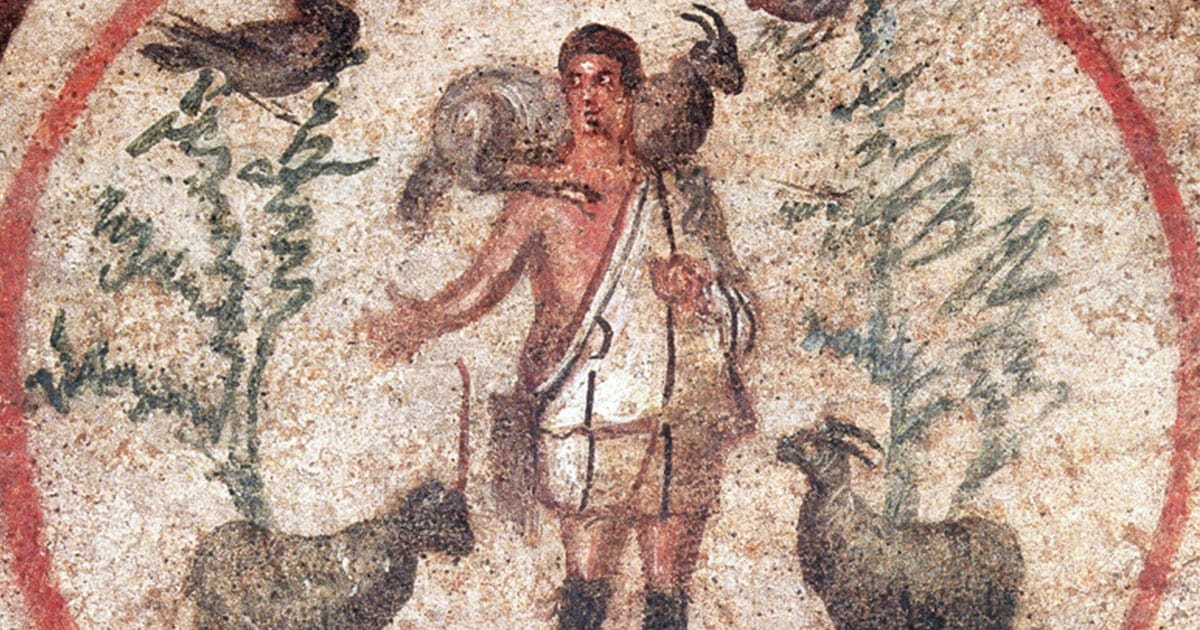
When insulted, we do not answer with insult. When wronged, we do not seek revenge. When misunderstood, we resist the temptation to distort truth for the sake of victory. This is not weakness. It is discipline. It is the strength to remain anchored in Christ rather than in the shifting currents of reaction. For Peter concludes with a profound image: “You were like sheep going astray, but now you have returned to the shepherd and guardian of your souls.”
“I am the gate” (John 10:1-10)
The Gospel brings us to the heart of the matter. Jesus says: “I am the gate.” It is a curious image—less familiar, perhaps, than that of the Good Shepherd. And yet it is no less significant. To understand it, we must briefly enter the world of ancient pastoral life. Shepherds would lead their flocks during the day to pasture and water. At night, the animals were gathered into an enclosure—a sheepfold—protected by walls or fencing. There was only one entrance. Sometimes, quite literally, the shepherd himself would lie across that opening, becoming the living gate. Nothing entered or exited except through him. It is against this background that Jesus speaks.
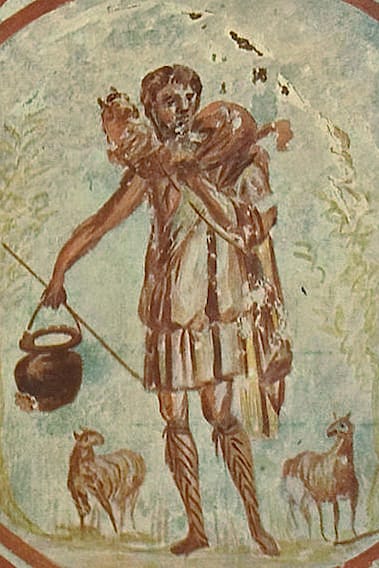
“All who came before me are thieves and robbers” - these are strong words. He is referring not only to false messiahs, but also to those religious leaders who claimed authority without truly guiding the people towards God. The prophet Ezekiel had already condemned such shepherds—those who fed themselves rather than the flock. Jesus’ claim is therefore both a revelation and a judgement. He is not one teacher among many. He is the decisive point of access.
“I am the gate. Whoever enters through me will be saved” - this is not an abstract statement. It has existential weight. To enter through Christ is to entrust oneself to him—not partially, but wholly. The image also carries a beautiful paradox. The gate both opens and protects. It allows passage, but it also establishes a boundary. Through Christ, one finds freedom and yet also security.
It is worth noticing that in John’s Gospel, Jesus repeatedly uses the phrase “I am”—echoing the divine name revealed to Moses. Here, too, he is not merely offering guidance; he is revealing his identity. He is not pointing to the way. He is the way.
There is a temptation, particularly in our time, to soften such claims. To say that Christ is a way among others. That different paths lead, ultimately, to the same destination. It is an attractive thought. It avoids conflict. It allows for a certain harmony of perspectives. But it is not what the Gospel says. If Christ is the gate, then he is not one entrance among many. He is the entrance. This does not mean that truth or goodness cannot be found outside explicit Catholic faith. But it does mean that all salvation—wherever it appears—flows through him. The real question, then, is through which gate am I trying to enter?
Modern life offers many alternatives—success, recognition, ideology, even forms of spirituality detached from commitment. Some of these may contain elements of truth. But none of them can bear the full weight of the human longing for life that does not end. There is also a more subtle danger: to profess Christ with words, but to live according to other principles. To admire him, but not to follow him. Yet, as today’s readings make clear, to choose Christ is not merely to assent to a doctrine. It is to adopt a way of life—marked by repentance, shaped by baptism, sustained by the Spirit, and expressed in a distinct pattern of conduct.
What, then, does it mean—practically—to pass through this gate? It means, first, to allow one’s thinking to be changed. To undergo that metanoia of which Peter speaks. Not simply adjusting behaviour, but reorienting one’s entire vision. It means, secondly, to live from the grace of baptism—not as a distant memory, but as a present reality. To remember that one’s life is already bound to Christ. It means, thirdly, to imitate him concretely. Especially in those moments where imitation is most difficult: when we are misunderstood, when we are treated unfairly, when we are tempted to respond in kind.
In our social and political life, this becomes particularly urgent. Christians may and should engage, defend what is true, and seek the common good. But they must never adopt the methods of falsehood or contempt. No cause—however noble—justifies abandoning the spirit of Christ. Finally, it means discerning carefully whom we follow. Not every voice that claims authority deserves trust. A true shepherd is recognised not by credentials alone, but by fidelity to Christ.
Fr Dominik Domagala
POINTS FOR PERSONAL MEDITATION:
First Reading (Acts 2:14, 36–41):
“What must we do?”
- When I hear Peter’s words—“God has made him both Lord and Christ”—do I truly accept Jesus as Lord of my life, or only as a figure of belief?
- Peter calls for repentance (metanoia)—a change of mind. In what concrete areas of my life is God asking me not just to improve, but to think differently?
- What does it mean for me personally that salvation is offered—but must be entered into?
Second Reading (1 Peter 2:20–25):
“Christ suffered for you, leaving you an example.”
- How do I normally respond to injustice, criticism, or misunderstanding—defensively, aggressively, or with patience?
- Do I believe that suffering, when united to Christ, can have meaning—or do I see it only as something to eliminate?
- Christ is called the “shepherd and guardian (episkopos) of your souls.” Do I truly entrust my life to His guidance, or do I rely primarily on my own calculations?
Gospel (John 10:1–10):
“I am the Gate.”
- Jesus says: “I am the gate.” Do I believe that He is the only way to true life, or do I treat Him as one option among many?
- What “other gates” am I tempted to enter—success, security, ideology, comfort, or human approval?
- Do I recognise the voice of Christ in my life—through Scripture, prayer, and the Church—or am I led by louder, more immediate voices?