Mass Readings:
- Acts 2:14, 22-33
- 1 Peter 1:17-21
- Luke 24:13-35
“Christ is risen”—the Church continues to proclaim in these Easter weeks. And we are expected to answer: “He is truly risen.” But if this exchange remains only a liturgical formula, a courteous echo of ancient words, then we have not yet understood its weight. The Resurrection is not a greeting. It is a claim upon our lives. It demands a response not merely of the lips, but of the whole person. This Sunday’s readings—from the preaching of Saint Peter and the Gospel of Saint Luke—press that question upon us with particular urgency: Do we truly live as those who believe that Christ is risen?
The centre of the Christian proclamation (Acts 2:14, 22-33)
The First Reading brings us back to the beginning—to the first public proclamation of the Church on the day of Pentecost. Saint Peter stands before the people of Jerusalem and delivers what can only be described as the programme of Christian faith. And what lies at its heart? Not a moral code. Not a philosophical system. But an event: the death and resurrection of Jesus Christ. Peter speaks with remarkable clarity. He recalls Jesus’ life, his miracles, his crucifixion. But he does not dwell there. The centre of his message is this: “God raised him up.” To support this, Peter turns to the Scriptures—especially the Psalms attributed to King David. He cites words that, for generations, had been prayed without full understanding: “You will not abandon my soul to Hades, nor let your Holy One see corruption.” Peter interprets these not as poetic reflections on David’s own fate, but as prophecy. David, he argues, foresaw the resurrection—not of himself (for his tomb was still known in Jerusalem), but of his descendant. This is a decisive move. From the very beginning, Christians read the Old Testament through the lens of Christ. What had once been hidden now stands revealed. Yet Peter does not stop at the Resurrection itself. He draws out its full implication: “God has made him both Lord and Christ, this Jesus whom you crucified.” To call Jesus “Lord”—Kyrios—is not a polite title. In the Greek Scriptures, this word replaces the very name of God, the sacred name once revealed to Moses. To confess Jesus as Lord is to recognise him as sharing in the divine authority itself. And “Christ”—the Messiah—means the anointed king, the one long awaited. But here, something new emerges. This kingship is no longer confined to an earthly realm. The risen Christ reigns from heaven. The people of God are no longer defined merely by geography or ancestry; they are gathered into a kingdom that already touches eternity.
It is no surprise, then, that the listeners respond with a question that echoes through every age: “What must we do?” Peter’s answer is direct: repent, be baptised, receive the Holy Spirit. The promise, he insists, is not limited to those present. It extends “to you, and to your children, and to all who are far away.” That includes us.
What is striking is how central the Resurrection is to this entire proclamation. Without it, everything collapses. Christianity is not built upon admiration for a great teacher, nor even upon reverence for a martyr. It stands or falls with the claim that Jesus has conquered death. If we wish to renew our faith, perhaps the first step is a reordering of priorities. It is easy to become preoccupied with secondary matters—with debates, with preferences, with particular devotions. Yet Peter reminds us: the heart of faith is not peripheral. It is the risen Christ himself.
A life shaped by redemption (1 Peter 1:17-21)
The Second Reading, taken from the First Letter of Saint Peter, turns from proclamation to consequence. What does it mean to live as one who believes in the Resurrection? Peter writes to Christians scattered across Asia Minor, living in a world that does not share their faith. He reminds them of their dignity—and their responsibility.
“You call on the Father who judges each one impartially according to his deeds” - this is a sobering reminder. God is indeed Father—but not in the sense of indulgence. He does not simply overlook wrongdoing. The relationship is real, and therefore it carries weight. To belong to God is not to escape judgement, but to live in its light. Peter goes on to describe the Christian condition with a striking image: we are living in exile. This world, for all its beauty and significance, is not our final home. Such a perspective brings balance. It frees us from both indifference and absolutism. We are called to engage in the world—to work, to build, to seek justice. But we must never forget that our ultimate destiny lies beyond it. This has practical implications. There are moments when we strive for what is good and just, and yet find ourselves unable to achieve it. The temptation then is to compromise—to adopt questionable means for the sake of a noble end. Peter offers a different path. Fidelity matters more than immediate success. The Christian does not measure everything by visible results. There is a deeper horizon.
Why? Because we have been “ransomed… not with perishable things such as silver or gold, but with the precious blood of Christ.” This is a profound claim. In the ancient world, redemption often meant the payment of a price to secure freedom. Here, the price is not material, but personal—the life of Christ himself, given in obedience even unto death. And this was no afterthought! Peter insists that Christ was “destined before the foundation of the world.” God’s plan of salvation is not a reaction to human failure; it is part of a design rooted in love and freedom. God does not force our response. He invites it. Through Christ, we have come to believe in God—not as an abstract principle, but as one who raises the dead and offers life beyond death. This calls us to live differently—to become, as it were, people illuminated by the Resurrection.
From confusion to recognition (Luke 24:13-35)
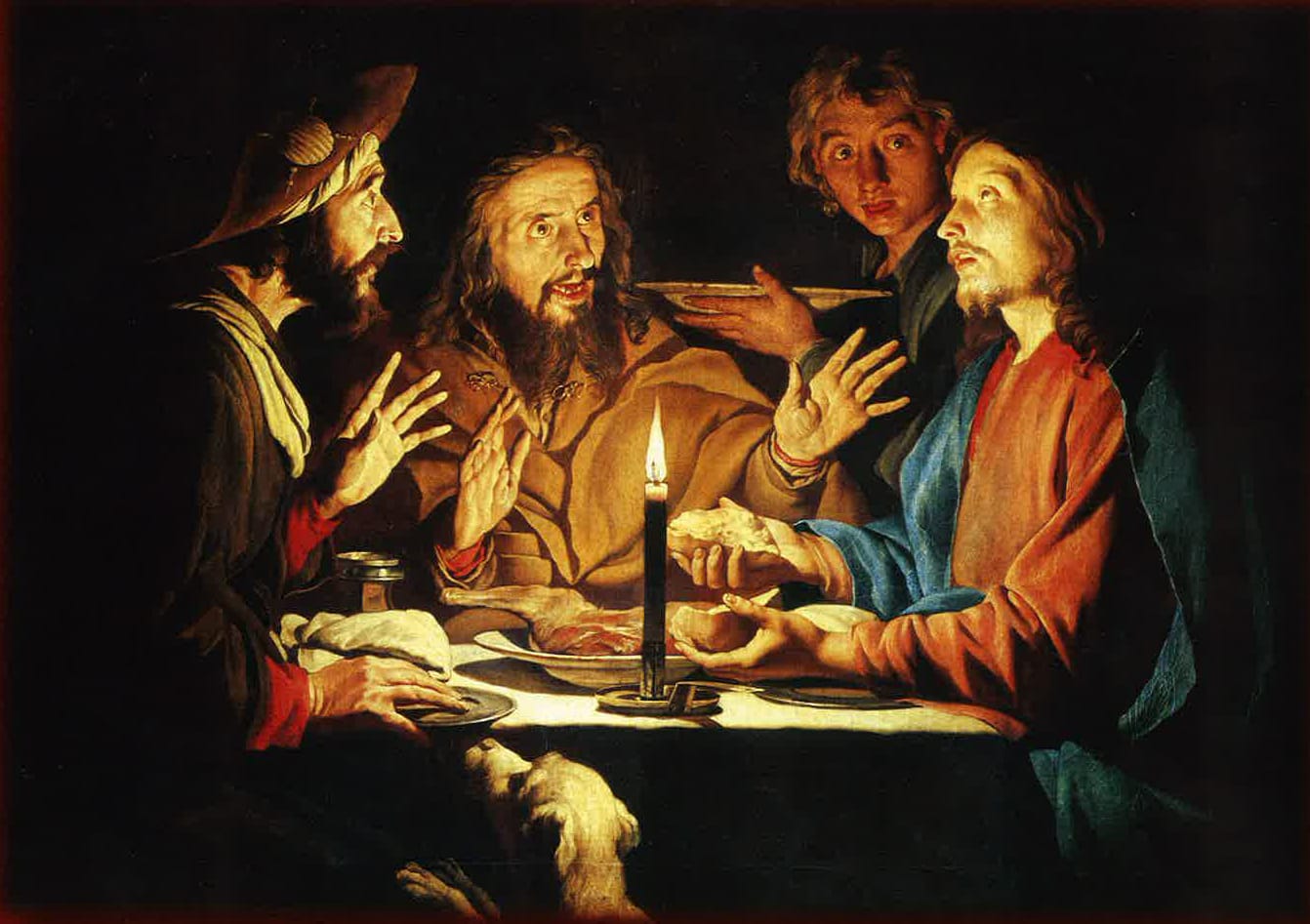
The Gospel presents us with one of the most beautiful and enigmatic scenes in all Scripture: the journey to Emmaus. Two disciples are walking away from Jerusalem. Their hopes have been shattered. They had believed that Jesus was the one to redeem Israel. Now he is dead. As they walk, they speak—perhaps with a mixture of sorrow, confusion, and quiet resignation. And then, a stranger joins them. We know, of course, that it is Jesus. But they do not.
Why? The text simply says that “their eyes were kept from recognising him.” The precise nature of this blindness remains a mystery. Was it psychological? Spiritual? A deliberate act of concealment? Whatever the explanation, one thing becomes clear: before they can recognise Jesus, they must first understand. The stranger listens, then responds—not with immediate revelation, but with teaching. He interprets the Scriptures, beginning with Moses and the prophets, showing how the Messiah had to suffer before entering into glory.
It is worth pausing here. Many have remarked that they would give much to hear such a discourse—to know exactly how the Old Testament points to Christ. And yet, in a sense, we already possess its substance. The preaching of the Apostles, including Peter’s speech at Pentecost, is rooted in this very instruction. Only after this long explanation does the moment of recognition come—at table, in the breaking of the bread. The gesture is familiar. It echoes the Last Supper. It anticipates the Eucharist: “And their eyes were opened, and they recognised him.” Then, just as suddenly, he vanishes. What remains is not confusion, but clarity. Not mere emotion, but a transformed understanding. The disciples say to one another: “Did not our hearts burn within us while he talked to us on the road, while he opened to us the Scriptures?” Their experience becomes a model of Christian life: the Word explained, the bread broken, the Lord recognised.
There is a subtle but important lesson here for us. The disciples’ recognition of Jesus does not come at the height of emotion, but after a process of instruction. In our time, there is often a strong emphasis on experience—on feelings, on moments of intensity. These are not unimportant. Faith is not meant to be cold or abstract. But emotion alone is fragile. It can fade. It can be shaken by difficulty. What sustains faith is a deeper foundation: understanding shaped by the Word of God. The disciples’ hearts burned not because they saw, but because they heard—and began to understand. Only then were they ready to recognise.
Finally, there is something quietly beautiful in the setting of this encounter. The risen Christ reveals himself not in the Temple, nor in a grand public event, but in the simplicity of a meal shared with two relatively unknown disciples. This breaking of the bread becomes the place of encounter. Here we glimpse something essential about the Eucharist. It is not reserved only for solemn occasions. It is meant to become the rhythm of Christian life—the place where the risen Lord continues to meet his people. Even in its simplicity, even when stripped of outward splendour, it remains what it is: the presence of Christ among us.
The question returns, as it must: Do we truly believe that Christ is risen? Not in theory, not in words alone—but in the shape of our lives. Do we place the Resurrection at the centre of our faith? Do we allow it to reshape our priorities, our choices, our understanding of success and failure? Do we seek Christ not only in moments of emotion, but in the patient listening to his Word and in the breaking of the bread? The disciples of Emmaus began their journey in confusion. They ended it as witnesses. So may it be with us.
Fr Dominik Domagala
POINTS FOR MEDITATION:
First Reading (Acts 2:14, 22-33):
- “Christ is risen” — is this for me a formula, or a fact that shapes my life?
- If Christ truly conquered death, what place should fear, anxiety, and ultimate insecurity have in my life?
- Do I build my faith around the Resurrection—or around secondary matters (opinions, devotions, preferences)?
- What would change today if I fully believed that Christ is alive and reigning?
Second Reading (1 Peter 1:17-21):
- Where in my life do I still resist metanoia—a real change of thinking?
- Do I treat sin seriously, or do I assume God will simply “overlook” it?
- Do I consciously live from my Baptism, or is it just a past event?
- Is my faith a response to God’s gift—or merely a habit inherited from others?
Gospel (Luke 24:13-35):
- In what areas of my life am I like the disciples—confused, disappointed, or losing hope?
- Do I allow Christ to walk with me in those moments—or do I walk alone?
- Am I willing to let Him explain my life through Scripture, even when it challenges me?
- What “false expectations” about God or life might I need to let go of?