

Mass Readings:
- Acts 1:1-11
- Ephesians 1:17-23
- Matthew 28:16-20
There are moments in the Gospel that seem strangely difficult for modern Christians to grasp emotionally. The Ascension is one of them. Christmas speaks immediately to the imagination: a child in Bethlehem. Good Friday confronts us with suffering we instinctively understand. Easter morning carries the joy of victory over death. But the Ascension? At first glance it almost feels like a departure scene, as though Christ simply leaves the world behind.
And perhaps that is why the feast is often underestimated. We celebrate it respectfully, but without much inner urgency. Yet the readings of this solemnity make clear that the Ascension is not the story of Christ disappearing. It is the story of His enthronement. Jesus does not withdraw from history. He enters fully into His kingship over history. The Church today desperately needs to recover that perspective.
Forty Days That Changed Everything (Acts 1:1-11)
The First Reading, taken from the opening of the Acts of the Apostles, serves as a bridge between Saint Luke’s Gospel and the story of the early Church. Luke addresses both books to the mysterious Theophilus — a name meaning “friend of God” or “beloved of God.” Perhaps he was a real person. Perhaps the evangelist intentionally leaves the identity open so that every believer might recognise himself within it. The Gospel and Acts are written, in a sense, for every “Theophilus”: every person who wishes to understand what Christ continues to do in the world. Luke summarises those forty days between the Resurrection and the Ascension in a strikingly brief way: Jesus appeared repeatedly to the disciples and taught them about the Kingdom of God. Yet when one reflects upon the Gospels, there is surprisingly little recorded about those conversations. The disciples meet the risen Christ; they eat with Him, walk with Him, touch Him. But very little detailed teaching survives. Why?
Perhaps because the entire New Testament already bears the imprint of those forty days. The evangelists write after Easter, looking back upon Christ’s life through the light of the Resurrection. They are no longer merely chroniclers recording isolated sayings and events. They are witnesses who have come to understand the deeper meaning of everything Jesus said and did. One senses this especially in the preaching of Saint Peter in the Acts of the Apostles. His speeches interpret the entire history of Israel in the light of Christ. The frightened fisherman from Galilee suddenly speaks with astonishing theological clarity. It is difficult not to suspect that much of this understanding was formed precisely during those hidden forty days with the risen Lord.
And then comes the Ascension itself. The disciples still misunderstand part of Christ’s mission. They ask whether He will now restore the kingdom of Israel. Even after the Resurrection they continue to think in national and political categories. Jesus gently redirects them. Their task is no longer to wait for the restoration of one earthly kingdom. Their mission is infinitely larger: “You will be my witnesses in Jerusalem, in all Judea and Samaria, and to the ends of the earth.” That sentence becomes the entire structure of the Acts of the Apostles. The Gospel moves outward in widening circles until it reaches the heart of the Roman Empire itself.
Christ Does Not Rise Into Space (Ephesians 1:17-23)
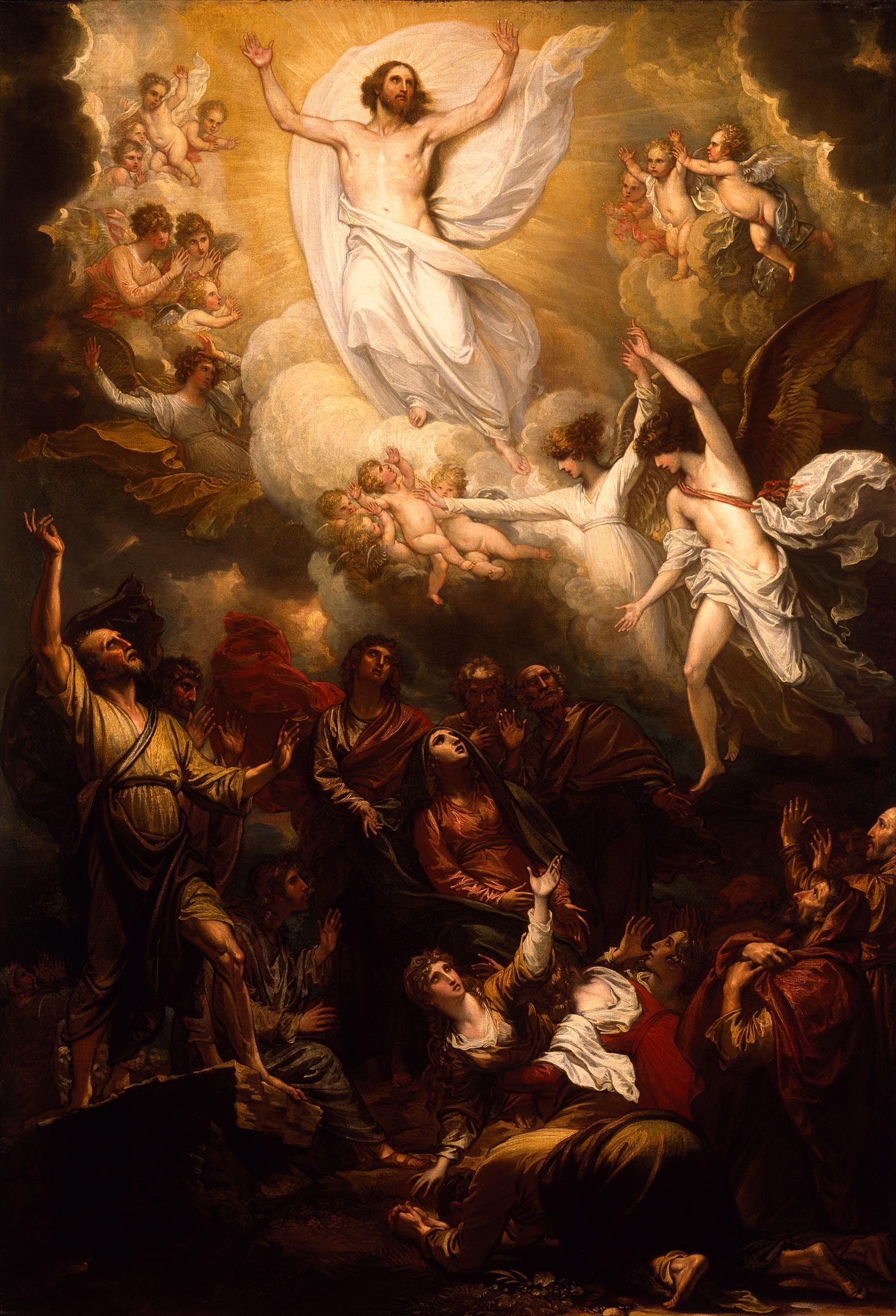
The image of the Ascension itself can easily be misunderstood if read superficially. Jesus is lifted up, and a cloud takes Him from their sight. Modern people sometimes instinctively recoil from such imagery, as though Christianity were presenting a primitive cosmology in which heaven exists somewhere above the clouds. But in biblical language the cloud is not meteorology. It is theology. Throughout Scripture the cloud signifies the presence of God: the cloud upon Sinai, the cloud filling the Temple, the cloud accompanying Israel through the desert. The Ascension does not mean that Christ travels into outer space. It means that He enters fully into the glory of the Father. Saint Paul explains this far more explicitly in the Letter to the Ephesians. Christ, raised from the dead, is now seated “at the right hand” of the Father. For the ancient world this was the language of royal authority. To sit at the king’s right hand was to share in his rule. The Ascension, therefore, is Christ’s enthronement. And Paul stretches language almost to its limits trying to describe the scope of that authority: Christ is above every power, dominion, authority and name — not only in this age but in the age to come. Everything has been placed beneath His feet. Modern Christians hear such phrases so often that we scarcely notice their audacity. But for the early Church this was astonishing. The man executed publicly outside Jerusalem — rejected, humiliated and crucified — is now proclaimed Lord of heaven and earth. Not one lord among many. Not a local tribal deity. Not a spiritual teacher competing alongside others. Lord of all.
Perhaps one of the quiet tragedies of modern Christianity is that we often no longer live as though we truly believe this. Christians frequently behave as though history ultimately belonged to political systems, cultural movements, financial structures or ideological battles. Anxiety becomes habitual. Fear becomes normal. We panic whenever the Church appears weaker socially or culturally. Yet the Ascension places everything into a radically different perspective. The One whom Christians follow already reigns. Not symbolically. Really. This does not eliminate suffering or failure. The Apostles themselves would face persecution, imprisonment and martyrdom. But it changes the horizon within which Christians live. They know who stands at the centre of reality. Saint Paul prays that the Ephesians may receive “a spirit of wisdom and revelation” so that “the eyes of their hearts” may be enlightened. That phrase feels remarkably contemporary. Many Christians today possess information about the faith, yet seem unable to see its grandeur. We often envy the world its pleasures, its wealth, its apparent freedom, while forgetting what has actually been promised to us. Paul insists that believers must rediscover “the hope of their calling” and “the riches of His glorious inheritance.” In other words: we must learn again what it means to belong to Christ.
The Great Mission Begins (Matthew 28:16-20)
The Gospel of Matthew approaches the Ascension differently. There is no visible rising into heaven. Instead, the evangelist ends with a mountain in Galilee, where the risen Christ gives His final commission to the Eleven. It is a strikingly realistic scene. The disciples worship Him — and yet some still doubt. Matthew does not conceal their hesitation. In fact, the honesty of the detail makes the Gospel more credible, not less. These are not idealised religious heroes. They are ordinary men slowly learning to trust something greater than themselves. And it is precisely to such imperfect disciples that Christ entrusts the future of the Church. “All authority in heaven and on earth has been given to me. Go therefore and make disciples of all nations.” The logic matters. Mission flows from Christ’s authority. The Apostles are not sent because they are exceptionally capable. They are sent because Christ reigns. And their task is carefully defined.
First, they are to make disciples of all nations. Christianity is universal from the beginning. The promise once given to Abraham — that all nations would be blessed through him — reaches fulfilment in Christ. Second, they are to baptise in the name of the Father, the Son and the Holy Spirit. Baptism is not merely symbolic belonging to a religious community. It is entry into the very life of God. Third, they are to teach people to observe all that Christ commanded. Christianity is therefore not simply a set of doctrines to be intellectually accepted. It is a way of life. The Sermon on the Mount, the commandment of love, forgiveness, humility, purity of heart — all of this belongs to discipleship. And finally comes the promise that changes everything: “I am with you always, until the end of the age.” This is perhaps the deepest meaning of the Ascension. Christ departs visibly so that He may remain universally present. The Church is never abandoned. However weak, wounded or confused Christians may sometimes become, they are not alone.
There is also an important practical lesson hidden within these readings. Christ sends His disciples to teach, baptise and proclaim hope. But nowhere does He tell them to evangelise through anger, humiliation or constant condemnation. A teacher who constantly shouts, ridicules and despairs is usually a poor teacher. The same applies to evangelisation.
The Gospel certainly contains demanding truths. Christ never reduces discipleship to comfort or easy optimism. But Christianity must still be presented fundamentally as good news. Too often believers speak about faith as though it were primarily a burden, a restriction, a chain around human freedom. The New Testament speaks differently. Again and again Christianity is presented as light, liberation, hope and life. The early Christians conquered the ancient world not because they were culturally dominant, but because they radiated conviction that Christ had truly changed everything. Perhaps that is what the Feast of the Ascension asks of the Church today: not triumphalism, but confidence. Not arrogance, but hope. Not panic, but faith that history ultimately belongs to the risen and ascended Christ. Because the Lord who ascended has not abandoned His Church.
Fr Dominik Domagala