
Mass Readings:
- 1 Kings 19:9, 11-13
- Romans 9:1-5
- Matthew 14:22-33
One of the most remarkable truths running through this Sunday's readings is that God is never anxious. Human beings panic, lose heart and imagine that everything is slipping beyond control, yet God never does. He remains Lord of history, quietly guiding His people through every storm, often not by removing their difficulties immediately but by giving peace to endure them. The Church's liturgical calendar beautifully echoes this message during the coming week. On Tuesday we celebrate Saint Clare of Assisi, a woman who found profound serenity in Christ despite living through an age of violence and political upheaval. On Saturday we celebrate the Assumption of the Blessed Virgin Mary, whose entire earthly pilgrimage was marked by unwavering trust in God's providence, a trust now crowned with the glory of heaven. Both remind us that peace is not the absence of difficulties but the fruit of complete confidence in the Lord. That is precisely the journey traced by today's Scriptures.
God Is Never in a Panic (1 Kings 19:9, 11-13)
The First Reading comes from one of the most dramatic moments in the life of the prophet Elijah. Only a short time earlier he had stood triumphantly upon Mount Carmel, defeating the prophets of Baal before the assembled nation. Fire had descended from heaven. The people had acknowledged the God of Israel. It appeared to be a decisive victory. Yet victory quickly gave way to fear. Queen Jezebel vowed revenge. Elijah fled into the wilderness, exhausted, discouraged and convinced that his mission had failed. His despair became so profound that he prayed for death. One cannot help noticing the remarkable contrast between Elijah's state of mind and God's response. The prophet is overwhelmed by emotion, but God never is. Rather than rebuking His exhausted servant, the Lord first provides food and water through His angel. Elijah is simply told to eat because the journey ahead will be too much for him. There is no dramatic speech, no condemnation, only patient care. Eventually Elijah reaches Mount Horeb—the very mountain where Moses had once encountered the living God and received the covenant. It is here that today's reading begins. The prophet expects another overwhelming display of divine power. A mighty wind tears across the mountain. An earthquake shakes the ground. Fire blazes before him. Yet Scripture quietly repeats the same refrain: the Lord was not in them. Instead, God comes in "the sound of sheer silence"—a gentle whisper, a still, small voice. Throughout Israel's history, divine manifestations were frequently accompanied by thunder, lightning, earthquakes and fire. Here, however, the Lord teaches Elijah—and us—that His deepest work is often accomplished without outward drama. The second-century Father of the Church, Saint Irenaeus, recognised in this passage a prophetic anticipation of Christ Himself. God's definitive revelation would come not through terrifying displays of force but through the humility and gentleness of the Incarnation. As Isaiah had foretold, the promised Servant would not break the bruised reed nor quench the smouldering wick. God's omnipotence is perfectly compatible with His gentleness.
The Patience of Divine Providence (Romans 9:1-5)
Saint Paul echoes this same confidence in today's passage from the Letter to the Romans. His heart is breaking. His fellow Israelites, the people to whom God entrusted the covenants, the Law, the promises and from whom Christ Himself came according to the flesh, have largely failed to recognise their Messiah. No sorrow could have wounded Paul more deeply. Yet even here despair does not have the final word. The Apostle knows that God's plan has not collapsed. Israel's rejection is neither absolute nor permanent. Over the following chapters of Romans he will explain that the Lord continues to guide salvation history with astonishing wisdom, bringing good even from human refusal. Once again we encounter the same divine pattern. Human beings panic because they see only the present moment. God remains serene because He sees the whole story. How often we resemble Elijah rather than the Lord.
We become discouraged by the state of the Church, anxious about the future of our families, distressed by cultural changes or overwhelmed by personal struggles. We are tempted to believe that everything depends upon our own efforts. Today's readings quietly remind us otherwise. God has not surrendered His governance of the world. His providence has never been interrupted. He still holds history—and our own lives—firmly within His loving hands. The saints understood this secret. Saint Clare certainly did. Her remarkable peace was not naïveté. It was the fruit of contemplating God who never loses control, even when His children imagine that all is lost.
Peace That Walks Upon the Waves (Matthew 14:22-33)
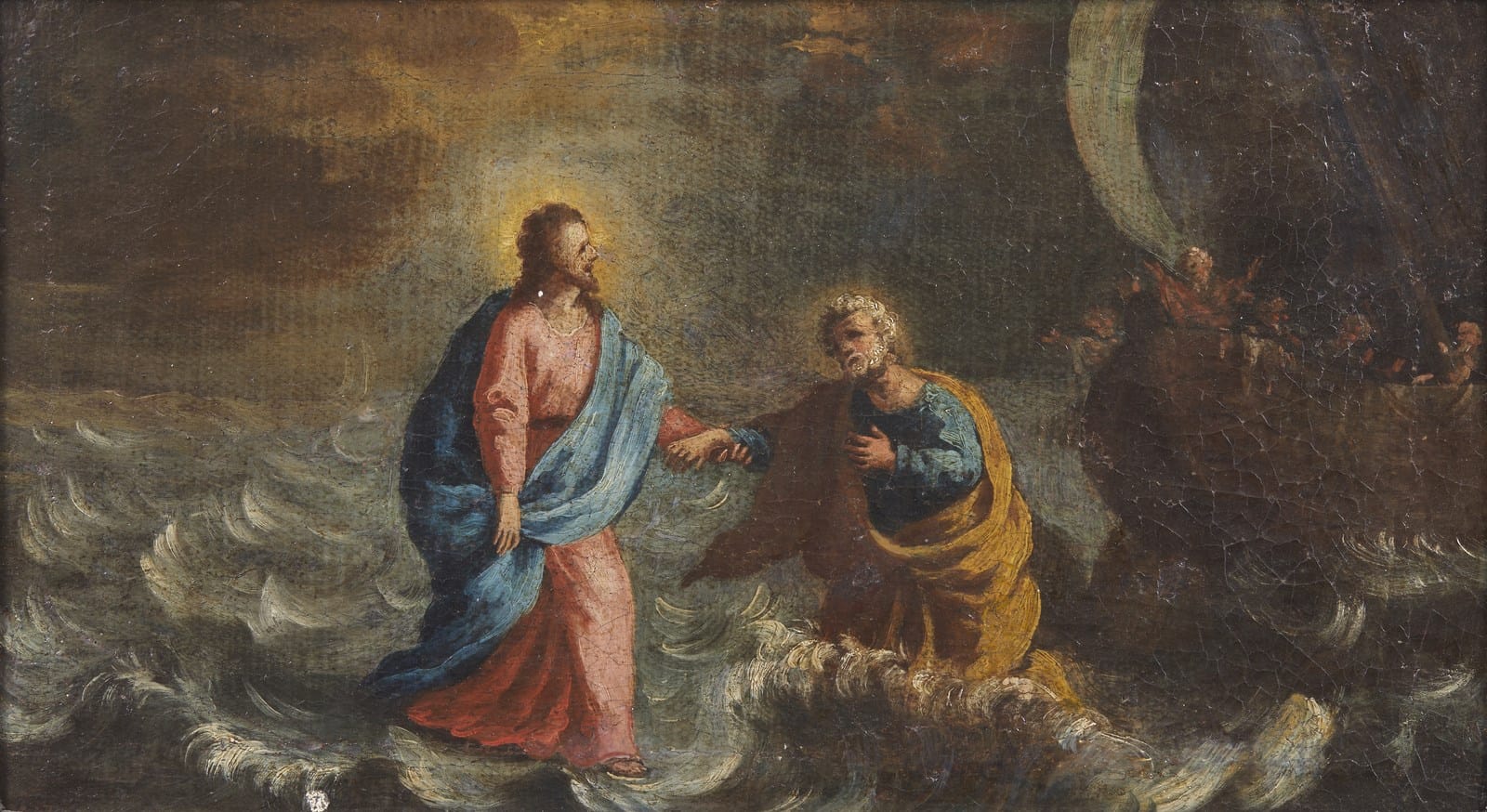
The Gospel carries this revelation one decisive step further. Immediately after the miraculous feeding of the multitude, Jesus sends His disciples ahead by boat while He withdraws alone to pray. Matthew mentions this almost in passing, yet it deserves our attention. Amid the demands of His public ministry, Jesus deliberately seeks silence before the Father. The One who will shortly calm the fears of His disciples first rests in the peace of prayer. There is an important lesson here. Christians are often tempted to think that prayer belongs only to moments when life becomes less busy. Jesus teaches precisely the opposite. Prayer is what allows us to remain peaceful in the midst of life's busiest and most demanding moments. Meanwhile, the disciples struggle against the wind for much of the night. The Sea of Galilee is by no means vast, yet hours pass and they make little progress. By the fourth watch—between three and six in the morning—they are exhausted. It is precisely then that Jesus comes to them, walking upon the water. For the first Christians, this miracle was never merely a spectacular display of supernatural power. Throughout the Old Testament, the sea symbolises the forces of chaos and evil, powers beyond human control. Only God can rule the waters. Job proclaims that the Lord alone "trampled the waves of the sea", while the Psalms repeatedly celebrate His dominion over the deep. Against this biblical background, Christ's words become even more striking. "Take courage. It is I. Do not be afraid.” The Greek text echoes the divine name revealed to Moses: I AM. Jesus does not simply reassure frightened fishermen. He reveals His own divine identity. The One walking towards them across the waves is none other than the Lord of creation itself. No wonder the disciples end by worshipping Him and confessing: "Truly, you are the Son of God.”
Peter's brief attempt to walk upon the water adds another layer to the story. As long as his attention remains fixed on Christ, the impossible becomes possible. The moment he begins to measure the strength of the wind rather than the faithfulness of his Lord, fear overwhelms him and he begins to sink. How often this becomes our own experience. The storms surrounding the Church are real. So too are our personal ones. Yet today's Gospel does not ask whether the waves exist. It asks where our eyes are fixed. When Peter cries out, "Lord, save me!", Jesus immediately stretches out His hand. His gentle reproach—"You of little faith, why did you doubt?"—is not intended to humiliate the Apostle but to teach him that confidence in Christ must endure even when circumstances appear threatening. This remains a permanent lesson for the Church. We shall never overcome evil merely by becoming louder than the world around us. The Kingdom of God grows wherever Christians allow the peace of Christ to become stronger than fear, resentment or despair. That has practical consequences. There is a great temptation today—even among sincere believers—to react to every crisis with outrage, harsh judgement or endless argument. Yet such behaviour rarely leads people closer to Christ. More often, it simply adds another wave to an already stormy sea. The Lord who revealed Himself to Elijah in the gentle whisper and to the Apostles with the calming words, "Do not be afraid", invites His disciples to become instruments of that same peace. A Christian home should be a place where anxiety is softened by trust. A parish should become a refuge where frightened people discover hope. Even ordinary conversations ought to bear witness that faith enables us to remain calm without becoming indifferent.
One Gift surpassing all other
This coming Saturday the Church celebrates the Assumption of the Blessed Virgin Mary. No disciple entrusted oneself more completely to God's providence than Mary. From the Annunciation to Calvary she walked a path she could never fully understand, yet she never ceased to believe that the Lord's promises would be fulfilled. Unlike Peter, she never allowed the storms to become greater than God's word. Her Assumption is therefore not simply a privilege granted to the Mother of God. It is a promise held before the entire Church. The peace born of trusting God is not an illusion for this life alone. It leads ultimately to the fullness of eternal glory. Perhaps that is the deepest invitation contained in today's readings.
The world will continue to experience storms. Also the Church herself will know moments of trial. Our personal lives will bring joys and sorrows in equal measure. Yet above every storm stands Christ. He is never overwhelmed by the winds that terrify us. He never abandons the boat that carries His disciples. He continues to whisper His reassuring words to every generation: "Take courage. It is I. Do not be afraid.” Those who learn to recognise His voice—like Elijah. Those who learn to trust His hand—like Peter eventually did. Those who persevere in quiet fidelity—like Saint Clare. And those who surrender themselves entirely to God's will—like the Blessed Virgin Mary—discover a peace that no storm can ever destroy. That is the peace Christ longs to place within every human heart, and through His Church, within the whole world.
Fr. Dominik Domagala acquired a Master's in History of Liturgy and obtained a Licentiate in Sacred Scripture at St Patrick’s College in Maynooth. His main interests concern the OT and Books of Maccabees. He is the author of “The Social Sermon” blog on Facebook, Instagram and YouTube. Check out more at the website: thesocialsermon.com