Dear Friends,
As we continue our Lenten journey, this coming Wednesday brings us to a feast that, at first glance, might seem to interrupt the penitential rhythm: the Annunciation of the Lord. And yet, if we look more closely, it leads us straight into the heart of Lent. The mystery we celebrate is not only about the fulfilment of God’s promise, but about something much more demanding: trust. Not a vague or comfortable trust, but one that is concrete, costly, and consistent.
In the attached homily, I reflect on the contrast between two figures: King Ahaz, who prefers security and calculation over faith, and Mary, who entrusts herself entirely to God, even without seeing the full path ahead. Between these two attitudes, we may recognise something of our own spiritual struggles. I also gently connect this mystery with the traditional devotion to the Seven Sorrows of the Blessed Virgin Mary. Mary’s “yes” at the Annunciation is not an isolated moment—it opens a path that will lead her all the way to the Cross. Her trust is not only beautiful; it is persevering.
Perhaps this is the question worth carrying into the coming days: Do I trust God only when things are clear and manageable, or also when His will unsettles my plans? As always, I hope this reflection will serve you not only for meditation, but also for preaching, prayer, or quiet reading.
With prayer and every blessing, fr Dominik
The solemnity we celebrate today draws us into one of the most decisive moments in the history of the world: the moment in which God’s promise—long awaited, often doubted, at times seemingly forgotten—begins to take flesh in a way no one could have foreseen. A virgin shall conceive. God Himself will enter human history. The Eternal will step into time.
And yet, while this mystery reveals the fidelity of God, it also exposes, perhaps uncomfortably, the fragility of human trust. For if there is one thread that unites today’s readings, it is this: God is trustworthy—yet people hesitate to entrust themselves to God.
The Refusal to Trust (Isaiah 7:10-14,8:10)
The figure of King Ahaz, presented in the first reading, is not merely a distant character from Israel’s past; he is, in many ways, a mirror in which every age—including our own—can recognise itself.
Faced with real danger, surrounded by political instability and threatened by hostile forces, Ahaz does what seems reasonable, even prudent: he seeks security through human alliances, calculating his chances, weighing risks, and ultimately placing his hope in the strength of a powerful empire. It is the logic of survival, the instinct of control, the strategy of self-preservation.
And yet, into this carefully constructed plan, God speaks. Through the prophet Isaiah, He invites the king to an altogether different path—not the path of calculation, but of trust. “Ask for a sign,” the Lord says, as though to reassure him that divine fidelity need not be taken on blind faith alone.
Ahaz refuses. And his refusal is clothed in pious language: “I will not ask; I will not put the Lord to the test.” It is a sentence that sounds devout, almost exemplary, and yet it conceals a deeper truth: not reverence, but distrust. For Ahaz has already decided where his security lies, and it is not in God.
Thus the prophet’s response carries a tone of restrained indignation: Is it not enough for you to weary men, that you also weary my God? In other words: do you truly believe that God is as powerless as the people you manipulate for your own ends?
And it is precisely at this moment—when human trust collapses into self-reliance—that God announces His own sign, independent of human consent or cooperation: “Behold, the virgin shall conceive and bear a son, and shall call his name Emmanuel—God with us.”
The Fulfilment of the Promise (Luke 1:26-38)
That sign, however, is not granted to Ahaz. It will not confirm the calculations of a king who refused to trust. It will instead be entrusted to someone entirely different: not to a ruler in Jerusalem, but to a young woman in an obscure village; not to one who relied on power, but to one who possessed nothing except openness before God.
In Mary, we encounter the exact opposite of Ahaz.
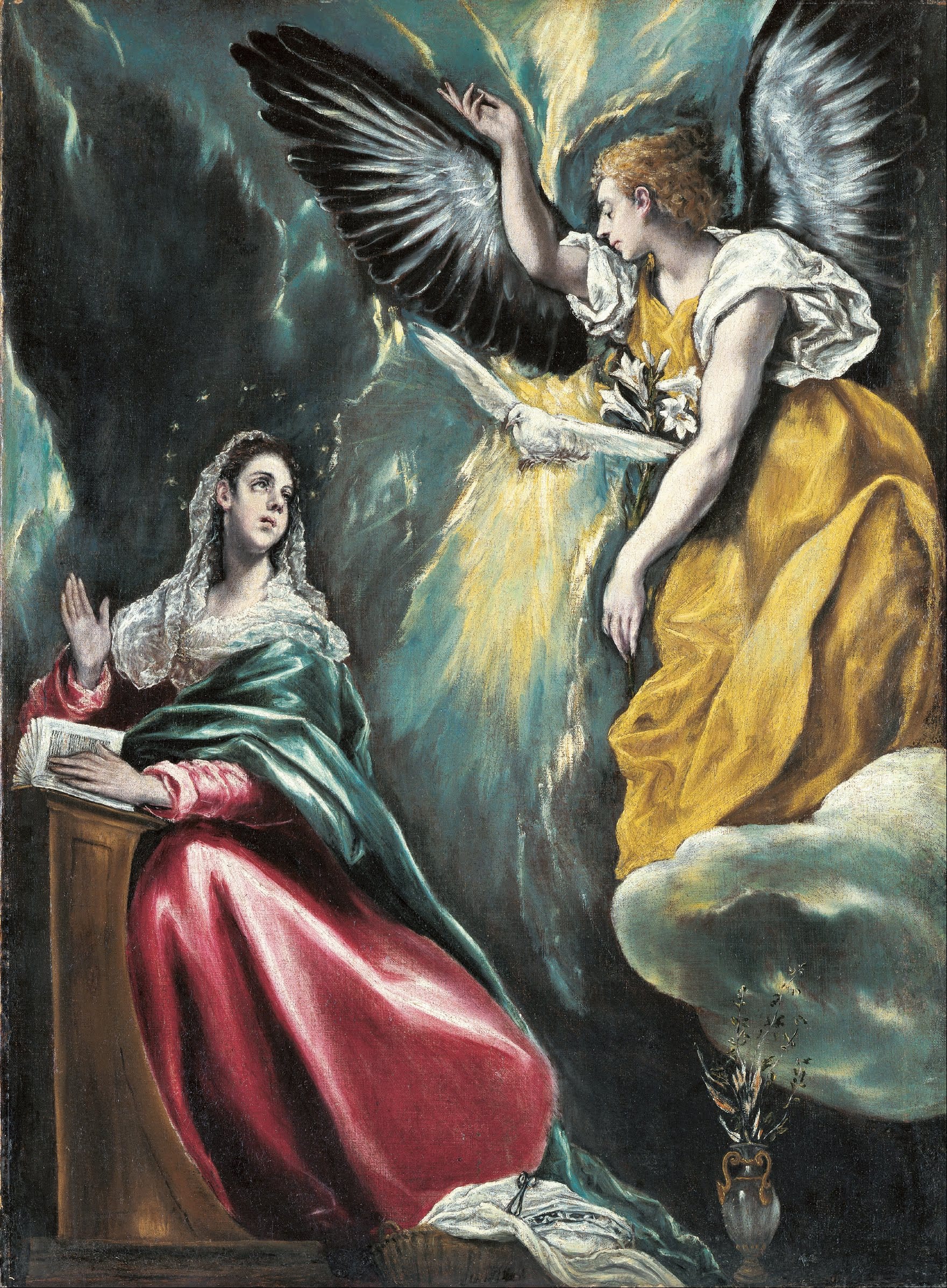
She too is confronted with a reality that surpasses all human categories. Her question—“How can this be, since I do not know man?”—is not the expression of scepticism, but of a lucid and sober faith that seeks understanding without demanding control. She does not deny the possibility of God’s action; she simply desires to perceive its meaning.
And when that meaning is revealed, even if only partially, she utters words that resound throughout all generations: “Behold, I am the servant of the Lord; let it be done to me according to your word.”
In that moment, trust ceases to be an abstract virtue and becomes a concrete act of self-surrender. Mary does not negotiate, does not postpone, does not seek guarantees. She entrusts herself—fully and irrevocably—to God whose ways she cannot fully grasp, but whose fidelity she does not doubt.
Yet it would be a mistake to sentimentalise this scene, as though Mary’s consent ushered her into a life of immediate clarity and peace. On the contrary, her “yes” opens the door to a path marked by uncertainty, misunderstanding, and, ultimately, suffering.
For the Church, in her wisdom, has always understood that the Annunciation cannot be separated from the Cross. Even in this Lenten season, when the modern liturgical calendar does not formally celebrate the commemoration, we remain conscious that this coming Friday we would traditionally recall the Seven Sorrows of the Blessed Virgin Mary. This is no coincidence, but a theological necessity.
The “fiat” pronounced in Nazareth finds its completion beneath the Cross. The trust that allowed God to enter the world is the same trust that remains steadfast when that world rejects Him. The obedience that welcomed life into her womb is the same obedience that endures as that life is offered up in sacrifice.
Thus, Mary’s faith is not a momentary enthusiasm, but a consistency of trust that spans from the promise to its fulfilment—through light and through darkness alike.
The True Sacrifice (Hebrews 10:4-10)
The second reading, drawn from the Letter to the Hebrews, provides the inner key to this mystery. It reminds us that what God ultimately desires is not external offerings, not ritual gestures detached from the heart, but obedience: “Behold, I have come to do your will, O God.”
In these words, placed on the lips of Christ at the very moment of His entrance into the world, we glimpse the profound unity between the Son and the Father. The Incarnation itself is already an act of obedience; the Cross will be its culmination, not its beginning.
And in a remarkable way, Mary’s response mirrors that of her Son. As He says, “I come to do your will,” she responds, “Let it be done to me.” The history of salvation unfolds through this convergence of divine initiative and human consent, of grace offered and trust given.
Our Own Hesitation
At this point, the Word of God inevitably turns toward us, and the question becomes unavoidable: where do we stand between Ahaz and Mary?
For it is easy to admire Mary’s faith, just as it is easy to judge Ahaz’s failure. Yet, in the concrete reality of our lives, we often discover that we resemble the latter more than the former.
We believe—but selectively.
We trust—but within limits.
We follow the Gospel—but we adapt it to what seems realistic, manageable, acceptable.
We build our security on what we can measure, predict, and control, and only afterwards do we ask God to bless what we have already decided. In doing so, we risk repeating the quiet tragedy of Ahaz: speaking the language of faith, while living by the logic of self-reliance.
And yet, the Annunciation stands before us as an invitation—perhaps even as a gentle provocation—to rediscover what it means to trust God consistently.
Such trust is never abstract. It takes shape in concrete choices: in the decision to forgive rather than to retaliate; to remain faithful when it would be easier to withdraw; to uphold truth when compromise would bring immediate advantage; to live according to the Gospel not only when it is convenient, but precisely when it is demanding.
To trust God is to accept that His ways may lead us beyond our calculations, and that fidelity to Him may at times appear, in the eyes of the world, as weakness or even folly. And yet, it is precisely this trust that opens space for God to act.
Dear Friends, the mystery we celebrate this Wednesday is not confined to the past. God who once waited for the “yes” of Mary continues, in a mysterious way, to await our own response. He does not impose Himself; He invites. He does not override our freedom; He honours it. And therefore, the question that remains is both simple and demanding:
Will we continue to rely primarily on our own calculations, like Ahaz, or will we dare—like Mary—to entrust ourselves to the word of God, even when it surpasses our understanding?
For faith begins precisely at that threshold where certainty ends, and trust becomes possible.
May we have the courage to cross that threshold, and to say, with her: “Let it be done to me according to your word.”
fr Dominik Domagala